What Makes a Case Worth Investigating?
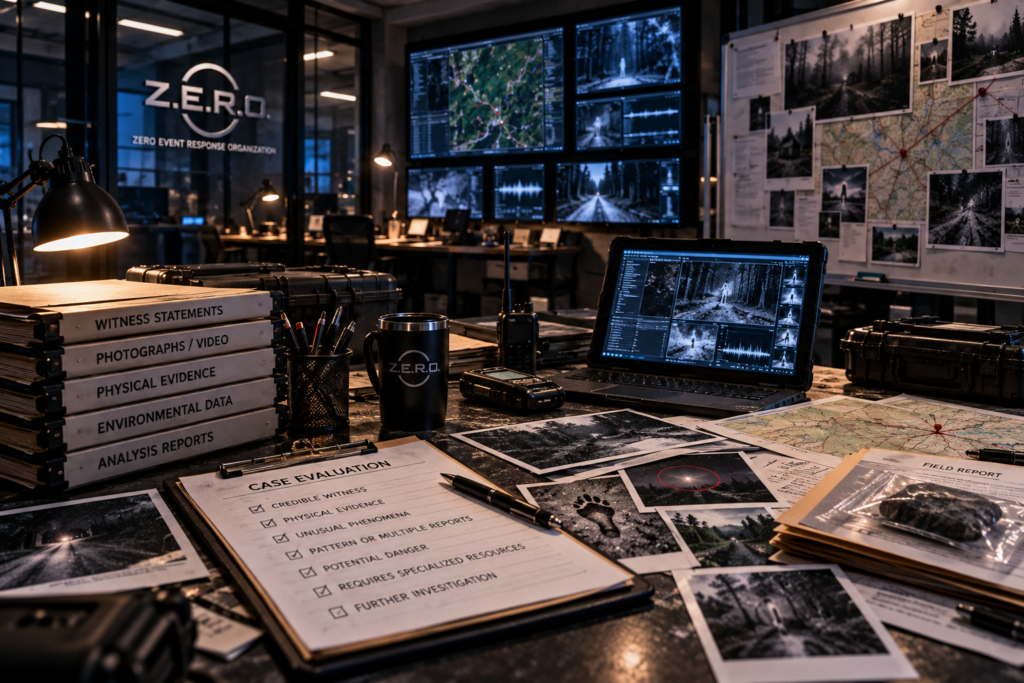
Not every strange occurrence is paranormal. Not every witness is mistaken. And not every mystery deserves the same response.
Every unexplained event begins somewhere. It might be a strange sound in an otherwise quiet building, an unusual object appearing in the sky, an unidentified creature encountered along a remote road, or a witness describing something that seems impossible.
Some reports can be explained almost immediately. Others require additional examination before investigators can determine what actually occurred.
But occasionally, an incident raises questions that cannot be answered through ordinary observation or conventional investigative methods.
Within the fictional universe of Z.E.R.O. — Zero Event Response Organization, deciding which incidents deserve further investigation is an important responsibility.
The organization cannot treat every unusual report as evidence of something extraordinary. Resources, personnel, equipment, and time must be directed toward incidents that warrant closer examination.
That raises an important question.
What makes a case worth investigating?
Every Report Begins With a Question
An investigation does not necessarily begin with proof that something unusual has happened.
More often, it begins with uncertainty.
Someone may report witnessing an unfamiliar creature. Another person might describe an unexplained light, a disturbing encounter, or physical evidence that seems inconsistent with the surrounding environment.
The initial account provides a starting point, but it does not establish the nature of the event.
Investigators must first determine what is actually being reported.
Where did the incident occur? What did the witness observe? How long did the event last? Were other people present? Is there physical evidence, photographic documentation, or additional information that can be examined?
These questions help establish the basic circumstances before anyone attempts to determine what caused the event.
The objective is not to immediately confirm or dismiss the witness’s interpretation.
It is to understand the available information.
The Credibility of Witness Testimony
Eyewitness accounts can provide valuable information, particularly when an incident occurs without recording equipment or other forms of documentation.
However, human perception is not infallible.
Lighting conditions, distance, emotional stress, unfamiliar environments, and the speed of an event can influence what someone believes they witnessed.
Memory can also change over time, especially when an individual repeatedly discusses an unusual experience or encounters information that influences their recollection.
These limitations do not automatically mean a witness is dishonest.
A person can sincerely describe an experience while misunderstanding certain details.
Within Z.E.R.O., the distinction between honesty and accuracy is important.
An investigator must evaluate the circumstances surrounding a statement rather than assuming that an extraordinary account is either completely accurate or deliberately fabricated.
Multiple witnesses may strengthen an investigation, particularly when their accounts contain independently consistent details.
But agreement alone is not conclusive. Investigators must also consider whether witnesses communicated with one another before providing their statements.
Credibility is established through careful evaluation, not simply through confidence or conviction.
The Importance of Physical Evidence
Physical evidence can significantly influence whether an unusual report warrants further investigation.
Photographs, recordings, biological material, unusual markings, damaged objects, and environmental measurements may provide information that can be independently examined.
For example, a reported encounter with an unidentified animal becomes a different type of investigation when investigators discover unusual tracks, biological samples, or other measurable evidence.
But the existence of physical evidence does not automatically establish an extraordinary explanation.
Tracks may belong to a known species. Unusual fibers may originate from manufactured materials. Environmental disturbances may result from natural processes or human activity.
The value of evidence depends on its authenticity, relevance, condition, and the methods used to examine it.
Within Z.E.R.O., recovered evidence must be documented and preserved appropriately so researchers can evaluate it without unnecessary contamination or loss of information.
A single unusual object may raise questions.
A collection of independently verifiable observations may provide a stronger reason to continue investigating.
When Ordinary Explanations Fall Short
One of the most important responsibilities of an investigator is considering conventional explanations before pursuing extraordinary possibilities.
An unfamiliar sound might originate from wildlife, machinery, or structural movement. Strange lights may result from atmospheric conditions, aircraft, reflections, or equipment.
Even apparently unusual biological evidence may have a familiar origin.
Investigators must evaluate these possibilities rather than assuming that an event is paranormal simply because its cause is not immediately obvious.
However, there is also a difference between identifying a plausible explanation and demonstrating that the explanation accounts for the evidence.
An investigator might suggest that an unusual light was caused by an aircraft, but that possibility should be evaluated against the object’s reported movement, location, timing, and any available recordings.
If the explanation does not adequately account for the observations, the investigation may need to continue.
The goal is not to reject conventional science.
It is to apply scientific reasoning carefully, including when the available evidence remains difficult to explain.
Patterns That Deserve Attention
A single unusual report may provide limited information.
But what happens when similar incidents occur repeatedly?
Reports from different witnesses, recurring disturbances in the same location, or repeated observations of unusual physical characteristics may suggest a pattern worth examining.
Investigators must determine whether those similarities are meaningful or coincidental.
For example, several people reporting strange sounds in the same building might indicate a recurring environmental or mechanical problem.
Alternatively, repeated incidents involving consistent physical evidence may justify more extensive examination.
Patterns become especially valuable when the reports are independently documented and contain details that cannot easily be explained through shared assumptions or outside influence.
Within Z.E.R.O., identifying meaningful connections between incidents can help investigators determine whether a report represents an isolated occurrence or part of a larger unresolved phenomenon.
However, similarities must be evaluated cautiously.
Two events that appear related may ultimately have entirely different causes.
Assessing Potential Danger
Not every investigation is initiated solely because something is mysterious.
Sometimes the possibility of danger makes further examination necessary.
An unidentified organism appearing near a populated area, an unexplained environmental disturbance affecting human health, or an incident involving serious physical injuries may require attention even when little is known about the cause.
In these situations, the immediate priority may be protecting people rather than determining whether the event is paranormal.
Investigators must consider the potential consequences of delaying a response.
Could additional people be exposed to danger? Is the environment safe to enter? Could an unidentified substance present a biological or chemical hazard? Does the situation require specialized protective equipment?
These questions influence the urgency and scope of an investigation.
Within Z.E.R.O., determining the appropriate response involves balancing scientific curiosity with practical safety considerations.
An event does not need to be supernatural to represent a serious threat.
And something unfamiliar should not automatically be treated as hostile.
The Role of Scientific Specialists
Some reports require knowledge beyond the experience of a general field investigator.
Unusual biological evidence may require examination by specialists familiar with anatomy, genetics, microbiology, or related disciplines.
Environmental disturbances may involve physics, geology, chemistry, or atmospheric science.
Complex recordings may require technical analysis to determine whether unusual visual or audio characteristics originated from the environment or the recording equipment.
Within Z.E.R.O., collaboration between investigators, researchers, and technical personnel is essential.
Different specialists may interpret the same evidence from different perspectives, identifying possibilities that others have overlooked.
Scientific disagreements can also be productive when they encourage closer examination of assumptions and methodology.
The purpose of involving specialists is not to make an investigation appear more extraordinary.
It is to improve the quality of the conclusions that can reasonably be drawn from the available evidence.
When Evidence Is Incomplete
One of the greatest challenges in investigating unusual events is determining what to do when the available information is insufficient.
A witness may provide a detailed account without supporting evidence. A recording may capture something unusual but lack enough clarity for identification.
Physical evidence may have been disturbed, contaminated, or removed before investigators arrived.
Sometimes an event cannot be recreated, and the conditions under which it occurred are no longer available for examination.
These limitations do not necessarily invalidate the original report.
They do, however, restrict what investigators can establish.
Within Z.E.R.O., an unresolved incident does not automatically become proof of an extraordinary phenomenon.
It remains unresolved until sufficient evidence supports a more specific conclusion.
Recognizing the limits of available information is an important part of maintaining investigative credibility.
Deciding When to Continue
Investigations require resources.
Personnel must be assigned, equipment prepared, travel coordinated, evidence examined, and research conducted.
Some cases may justify extensive scientific study, while others may be resolved through preliminary evaluation.
An investigation may continue when credible evidence remains unexplained, when public safety concerns persist, or when additional examination has a reasonable possibility of producing useful information.
Conversely, an investigation may be concluded when the evidence supports a conventional explanation or when further examination is unlikely to produce meaningful results.
There is also a difference between closing an investigation and proving that nothing unusual occurred.
A case may remain unresolved because the available information is insufficient.
That uncertainty can be frustrating, but it is preferable to presenting an unsupported conclusion as fact.
Sometimes the most responsible decision is acknowledging that the answers are not yet available.
The Human Side of an Investigation
Behind every report is a person who experienced something they may not understand.
Some witnesses may be frightened. Others may be embarrassed, confused, or concerned that nobody will believe them.
A person reporting an unusual event may also be dealing with injury, property damage, personal loss, or other consequences unrelated to whether the incident ultimately proves extraordinary.
These individuals deserve to be treated with professionalism and respect.
Investigators should avoid encouraging unsupported interpretations, but they should also recognize that dismissive treatment can discourage witnesses from providing useful information.
Within the Z.E.R.O. universe, the human consequences of an event are just as important as the scientific questions it raises.
An investigation is not simply an opportunity to discover something unusual.
It may also involve people whose lives have been affected by circumstances they cannot explain.
Not Every Case Will Have an Extraordinary Answer
One of the defining principles behind Z.E.R.O. is that not every investigation must reveal a creature, an unknown entity, or a phenomenon beyond scientific understanding.
Some incidents may be resolved through ordinary investigative work.
Others may reveal misunderstandings, environmental conditions, previously overlooked evidence, or deliberate deception.
These outcomes are not failures.
They demonstrate the importance of examining reports objectively rather than attempting to prove a predetermined conclusion.
An organization dedicated to investigating the unknown must be willing to accept ordinary explanations when the evidence supports them.
Otherwise, the investigation becomes an exercise in confirming expectations rather than discovering the truth.
The credibility of an organization depends as much on the cases it can explain as on the mysteries it cannot.
The Questions That Remain
What makes a case worth investigating is not necessarily how frightening, unusual, or dramatic the initial report sounds.
It is the combination of credible information, available evidence, potential consequences, and unanswered questions that justify further examination.
Within Z.E.R.O., some investigations may begin with little more than a witness statement.
Others may involve substantial physical evidence, unexplained injuries, unusual environmental measurements, or discoveries that challenge established scientific expectations.
Each situation requires careful judgment.
The organization must determine what can be verified, what remains uncertain, and whether further investigation is justified.
Sometimes the answers will be ordinary.
Sometimes they will be extraordinary.
And sometimes, the evidence will lead to questions nobody expected to ask.
Because the most important question isn’t whether something sounds impossible. It’s whether the evidence gives us a reason to investigate.
Ginger Yarbrough
Creator and Author of Z.E.R.O. — Zero Event Response Organization