The Science Behind Z.E.R.O.’s Containment Chambers
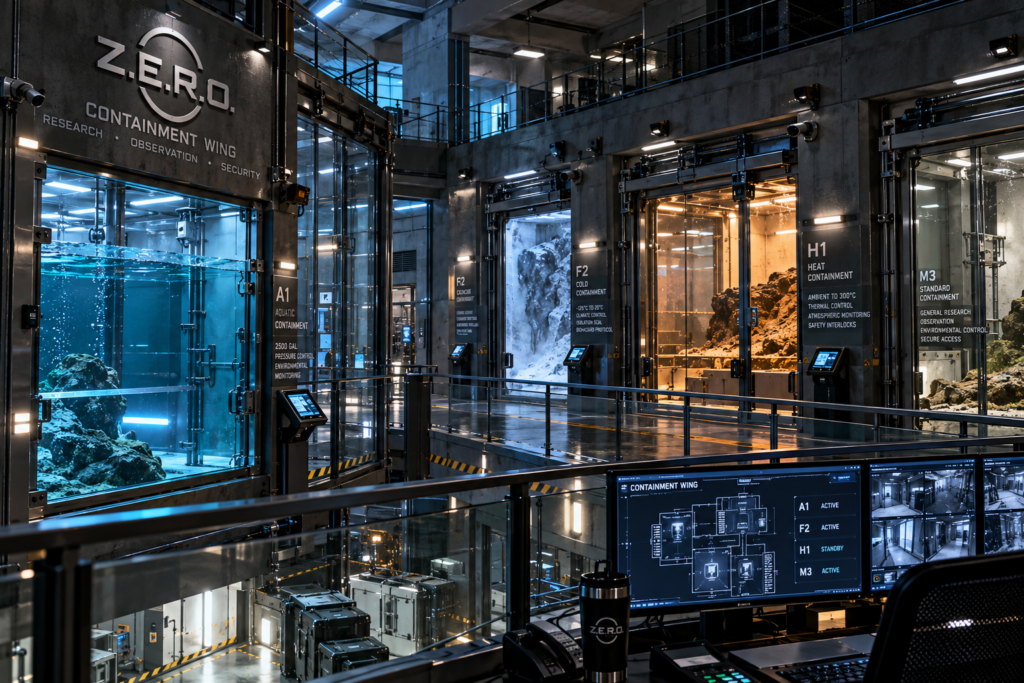
When an unknown organism cannot be safely studied in an ordinary laboratory, the environment surrounding it becomes just as important as the organism itself.
Imagine discovering a living organism that cannot be identified through any existing biological classification. Its anatomy is unfamiliar, its behavior unpredictable, and its response to ordinary environmental conditions remains unknown.
How would scientists study something like that safely?
Would a conventional laboratory be sufficient? Could ordinary containment materials withstand its physical capabilities? What if the organism required an environment entirely different from anything found on the Earth’s surface?
These are the kinds of questions that shape the containment operations within Z.E.R.O. — Zero Event Response Organization.
Unlike ordinary storage facilities, Z.E.R.O.’s containment chambers are designed to provide controlled environments for observing, studying, and securing unusual biological specimens and other potentially hazardous discoveries.
But creating a containment chamber involves considerably more than constructing reinforced walls and installing a secure door.
It requires an understanding of physics, engineering, environmental control, biological safety, and the unpredictable nature of unfamiliar organisms.
Containment Is Not Simply Imprisonment
One of the most important distinctions in scientific containment is the difference between restricting movement and maintaining a controlled environment.
In conventional research facilities, containment systems are designed around known hazards. Biological laboratories may use controlled airflow, specialized filtration, sealed workspaces, and protective barriers to reduce the possibility of exposure or contamination.
However, these systems are developed according to the characteristics of the materials or organisms being studied.
What happens when those characteristics are unknown?
Within Z.E.R.O., investigators and researchers may encounter organisms whose biological requirements, physical capabilities, or environmental tolerances have never been documented.
A chamber suitable for one specimen may be entirely inappropriate for another.
Some organisms may require carefully regulated temperatures. Others may need aquatic environments, specialized atmospheric conditions, or protection from external contamination.
The challenge is creating an environment that protects both the researchers and the organism while allowing meaningful scientific observation.
Engineering for the Unexpected
The structural design of a containment chamber must account for the forces it may encounter.
In conventional engineering, materials are selected according to their strength, durability, chemical resistance, thermal properties, and expected operating conditions.
Containment systems may incorporate reinforced structural components, controlled access points, monitoring equipment, and redundant safety mechanisms.
However, an unfamiliar organism introduces additional uncertainty.
Researchers may not initially know how much physical force it can exert, whether it produces corrosive substances, or whether it responds unpredictably to particular materials.
These uncertainties make preliminary observation and risk assessment especially important.
Within Z.E.R.O., containment engineering represents an ongoing relationship between scientific discovery and technological adaptation.
The more researchers learn about a specimen, the better they can understand the environmental and structural requirements necessary for studying it safely.
Environmental Control and Biological Stability
Temperature, humidity, atmospheric composition, pressure, and lighting can all influence biological activity.
In ordinary laboratories, environmental control systems help researchers maintain consistent conditions and reduce variables that could interfere with experiments.
For unfamiliar organisms, these controls may become essential to survival.
A specimen adapted to extremely cold conditions may not tolerate ordinary room temperatures. An aquatic organism may require carefully maintained water chemistry and pressure. Another life-form might respond adversely to lighting conditions that humans consider harmless.
Z.E.R.O.’s specialized containment facilities allow researchers to investigate these requirements under controlled conditions.
But maintaining an appropriate environment also introduces important questions.
How can researchers determine what conditions an organism requires without exposing it to unnecessary harm? How can they distinguish normal behavior from a stress response? And how can they maintain safe conditions when the organism’s biology is not yet understood?
These are scientific challenges rather than simple engineering problems.
Observation Without Unnecessary Exposure
One of the primary advantages of a controlled containment environment is the ability to observe an organism while reducing direct contact.
In conventional scientific research, remote cameras, environmental sensors, and automated monitoring systems can collect information without requiring personnel to remain physically close to potentially hazardous materials.
Within Z.E.R.O., observation is especially important because unfamiliar organisms may respond unpredictably to human presence.
Monitoring equipment can help researchers document movement, behavior, environmental changes, and responses to controlled conditions.
However, observation alone does not necessarily explain what researchers are witnessing.
An unusual movement might represent communication, defensive behavior, feeding activity, or a response to environmental stress.
Understanding the difference requires careful analysis over time.
And sometimes, the most important discovery comes from recognizing that an organism is behaving in a way nobody anticipated.
The Responsibility of Containment
Scientific containment raises questions that extend beyond engineering and laboratory safety.
If an organism is dangerous, how should researchers balance the need for study against the possibility of escape or exposure?
If it demonstrates intelligence, how should that influence the way it is treated?
And if a specimen poses no immediate threat, is continued containment always justified?
These questions become especially important within the Z.E.R.O. universe, where not every unfamiliar creature is necessarily hostile.
The organization must consider the safety of its personnel, the surrounding population, and the organisms under investigation.
Containment should serve a scientific and protective purpose rather than exist simply because something is unusual.
When Science Meets the Unknown
The containment chambers within Z.E.R.O. represent one of the most challenging aspects of investigating phenomena beyond established scientific understanding.
They combine structural engineering, environmental science, biological research, monitoring technology, and safety procedures within facilities designed to accommodate discoveries that may have no known precedent.
But no containment system can eliminate every uncertainty.
Technology can provide controlled conditions. Engineering can establish protective barriers. Scientific instruments can collect measurable information.
Understanding what has been contained is another challenge entirely.
Because sometimes the greatest difficulty isn’t keeping the unknown inside a chamber. It’s discovering what the unknown actually needs, what it is capable of, and whether it should be there at all.
Ginger Yarbrough
Creator and Author of Z.E.R.O. — Zero Event Response Organization