Why the Smallest Details Matter in an Investigation
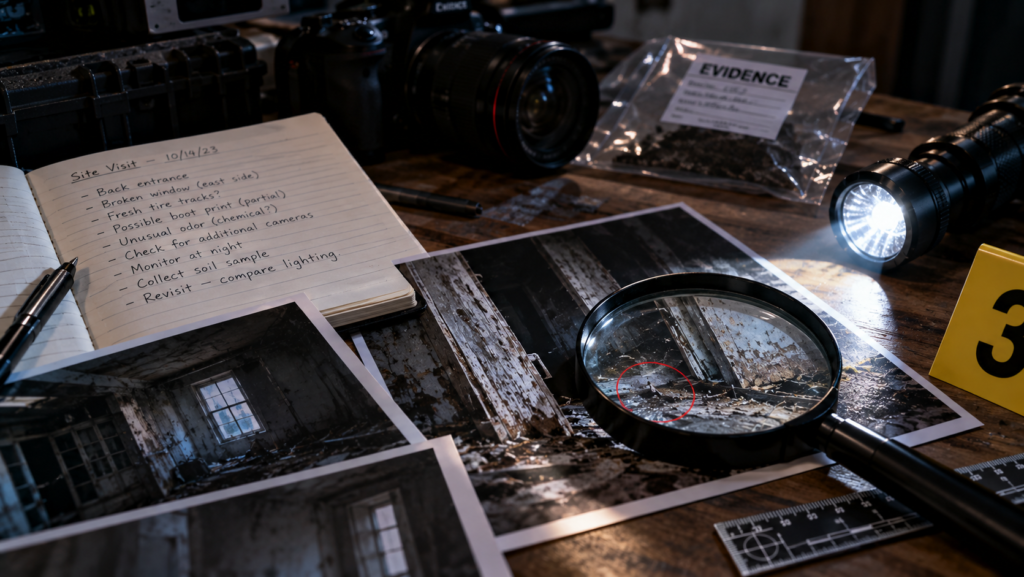
An investigation does not always change direction because of a dramatic discovery. Sometimes, the most important development comes from something so small that nearly everyone overlooks it. A faint mark on a window, an unusual reflection in a photograph, a minor discrepancy in a witness statement, or an object that appears slightly out of place can become the detail that forces investigators to reconsider everything they thought they understood.
People naturally tend to focus on the most noticeable aspects of an unusual event. If a witness reports seeing an unidentified figure near an abandoned building, attention may immediately turn toward the figure’s appearance, movements, and possible identity. If an unexplained light appears in a recording, investigators may concentrate on its brightness, shape, and direction of travel. Yet the surrounding details, including environmental conditions, camera placement, background sounds, and the timing of events, may ultimately provide more useful information than the unusual observation itself.
This is one of the reasons careful investigative work requires patience. Evidence rarely arrives in a perfectly organized collection that immediately reveals what happened. Instead, investigators must examine individual observations, compare them with other findings, and determine whether apparently insignificant details have a meaningful connection to the event. Sometimes those details confirm an existing explanation, while others reveal that the original assumptions were incomplete or entirely incorrect.
The Difference Between Looking and Observing
There is an important difference between looking at something and carefully observing it. Looking involves directing attention toward an object or event, while observation requires recognizing and documenting relevant details without immediately assigning them an explanation. In an investigation, that distinction can determine whether important information is preserved or overlooked.
Consider an investigator examining an abandoned building where unusual noises have been reported. At first glance, the location may appear straightforward. The windows are damaged, the doors are unsecured, and the interior contains debris left behind after years of neglect. A quick inspection might identify several possible explanations for the sounds, including wind moving through broken openings or animals occupying the structure. However, a more careful examination could reveal details that change how those possibilities are evaluated.
Perhaps one window is intact while the others are broken, or a particular door shows signs of recent movement despite appearing unused for years. A faint trail through accumulated dust might suggest that someone or something recently passed through an area. These observations do not automatically establish what occurred, but they provide information that can be compared with witness accounts, environmental conditions, and other evidence.
The purpose of careful observation is not to turn every scratch, stain, or unusual mark into a mystery. It is to recognize potentially relevant information while maintaining enough skepticism to distinguish meaningful evidence from ordinary environmental details.
When a Photograph Reveals More Than Expected
Photographs are valuable investigative tools because they preserve visual information that may be examined long after an event has ended. However, the most important detail in a photograph is not always the subject that originally attracted attention. Background objects, reflections, shadows, and environmental features can sometimes provide information that changes the interpretation of the entire image.
Imagine a witness photographing an unusual light above a wooded area. The light appears bright and unfamiliar, and the witness believes it was moving independently through the sky. Investigators examining the image might initially focus on the shape and brightness of the object, but a closer examination could reveal a faint reflection from a nearby window. If the photograph was taken through glass, that detail might suggest that the apparent object originated from a light source behind the camera rather than from something outside.
In another situation, a photograph of an unfamiliar figure may contain a recognizable fence, doorway, or vehicle that provides a useful reference for estimating size. Without those references, the figure might appear much larger or smaller than it actually was. Even the position of shadows can help investigators evaluate whether a photograph is consistent with the reported lighting conditions, although such comparisons require careful consideration of camera settings and environmental factors.
The important lesson is that photographs should be examined as complete records rather than isolated images of unusual subjects. The surrounding details may provide context that the photographer did not recognize when the picture was taken, and those details can become essential when determining what the image genuinely establishes.
The Importance of Time and Sequence
A minor difference in timing can significantly affect an investigation. Witnesses may remember events occurring in a particular order, but human memory is not always precise when estimating time, especially during unexpected or stressful situations. A person who believes an encounter lasted several minutes may have experienced a much shorter event, while someone recalling a sequence of sounds and movements may unintentionally reverse their order.
Investigators therefore examine timestamps, communication records, recordings, and other available information to establish a reliable sequence of events. Even a discrepancy of a few seconds can become important when comparing multiple cameras or determining whether two observations involved the same incident. However, timestamps must also be evaluated carefully because recording devices may have incorrect clock settings or may not be synchronized with one another.
Consider a report involving a sudden flash of light followed by an unusual sound. A witness may remember hearing the sound immediately before seeing the flash, while a recording suggests the opposite sequence. That difference could influence which explanations remain plausible, but investigators would first need to consider whether the recording equipment introduced delays or whether the witness’s recollection was affected by the unexpected nature of the event.
Establishing an accurate timeline is rarely as simple as arranging statements in chronological order. It requires comparing independent sources, identifying potential errors, and acknowledging uncertainty when precise timing cannot be established.
Small Changes in the Environment
Environmental conditions can influence both the occurrence of an event and the way it is perceived. Temperature, humidity, wind, lighting, precipitation, and surrounding activity may affect what witnesses observe and what recording equipment captures. A detail that initially appears unrelated to an investigation can become important when it reveals how those conditions changed during the reported incident.
For example, a witness may describe hearing footsteps inside an empty building shortly after sunset. Investigators examining the structure might discover that certain materials produce audible sounds as temperatures change. Wood, metal, and other construction materials can expand or contract, while air pressure differences may cause unsecured doors or panels to move. Understanding the timing of those environmental changes could help explain why particular sounds occurred.
Outdoor investigations introduce additional variables. Rain can alter footprints and other ground impressions, wind can move branches or debris, and changing light can affect the apparent size or shape of distant objects. Even a slight change in the position of the observer may alter what is visible through trees, buildings, or other obstacles.
These details do not mean every unexplained report has an ordinary environmental explanation. They demonstrate why investigators must understand the circumstances surrounding an event before deciding whether an observation is genuinely unusual.
When Witnesses Remember Different Details
Eyewitness accounts often contain information that cannot be recovered through physical evidence alone. A witness may remember a particular sound, an unusual smell, the direction of movement, or the behavior of nearby animals. These observations can provide useful investigative leads, especially when the event occurred outside the range of available cameras or recording equipment.
However, witnesses do not always notice or remember the same details. Two people observing an event from different positions may focus on different aspects of what happened. One may remember the color of a light, while another recalls the direction in which it moved. Their accounts may initially appear inconsistent, but those differences do not necessarily mean either person is being dishonest.
Investigators must also distinguish between details recalled independently and information introduced through later conversations. When witnesses discuss an event before providing formal statements, their memories may be influenced by what others describe. A detail that appears in several accounts may therefore be less independent than it initially seems.
This is why careful interviewing matters. Open-ended questions can allow witnesses to describe their experiences without being directed toward a particular explanation, while follow-up questions can help clarify details such as distance, lighting, and duration. Even when a small observation cannot be independently verified, documenting it accurately may become valuable if additional evidence emerges later.
The Evidence That Almost Gets Thrown Away
Not every potentially important piece of evidence looks unusual. A fragment of material, a small stain, a damaged object, or an ordinary item found near an incident may initially seem unrelated to the investigation. Without sufficient context, investigators may have difficulty determining whether such objects are relevant or simply part of the surrounding environment.
The location and condition of an item can sometimes be as important as the item itself. A piece of fabric found beside a damaged fence may provide little information until it is compared with other materials or examined for signs of how it became attached. A small fragment recovered from an unusual scene may require laboratory analysis before investigators can determine its composition or possible origin.
Preserving the relationship between evidence and its original location is therefore essential. Photographs, measurements, collection notes, and appropriate packaging help establish where an item was found and how it was handled. Without that documentation, even an interesting laboratory result may be difficult to interpret because investigators cannot reliably connect it to the reported event.
The goal is not to collect every object at a location indiscriminately. Investigators must make informed decisions about what is potentially relevant while avoiding unnecessary disturbance or contamination. Careful documentation can help preserve information that may become significant later, even when its importance is not immediately apparent.
When Technology Misses Something
Modern investigative equipment can collect information that human observers might otherwise overlook. Cameras, audio recorders, thermal imaging devices, environmental sensors, and other instruments can provide measurements or recordings that help investigators evaluate unusual reports. However, no instrument captures every aspect of an environment, and each operates within technical limitations that must be understood.
A camera may record movement outside the range of a nearby motion sensor, while a microphone may capture a sound that was masked by background noise for someone standing at the scene. A thermal camera measures infrared radiation and displays apparent temperature differences, but it does not directly identify the cause of every unusual pattern. Reflective surfaces, environmental conditions, and equipment settings can influence the resulting images.
Sometimes, the smallest technical detail explains an apparent contradiction. A recording device may have been positioned at an unexpected angle, a sensor may have been partially obstructed, or a camera’s automatic exposure may have changed during the event. These circumstances can alter the information collected without indicating that the equipment malfunctioned.
Investigators who understand their instruments are better prepared to recognize such limitations. Rather than treating every unusual reading as extraordinary, they examine how the measurement was obtained and whether the result can be reproduced or independently verified.
The Danger of Overlooking Ordinary Explanations
When an investigation involves an unusual or frightening report, there can be a temptation to focus primarily on the most dramatic possibilities. An unfamiliar sound may be interpreted as evidence of an unknown creature, while a strange light or unexplained movement may immediately attract speculation about paranormal activity. Although extraordinary possibilities can be compelling, concentrating on them too early may cause investigators to overlook simpler explanations supported by the available evidence.
This problem is closely related to confirmation bias, which can influence how people select and interpret information. Once an investigator develops a preferred explanation, details that support it may receive more attention than those that challenge it. A small observation that contradicts the original theory may be dismissed as unimportant, even though it could provide the key to understanding what happened.
A responsible investigation requires the willingness to reconsider assumptions. If an unusual noise is initially believed to originate from an unidentified animal, evidence of loose mechanical equipment should still be examined. If a witness reports seeing a figure disappear, investigators should consider visibility, obstacles, and possible routes before concluding that the figure vanished through extraordinary means.
Ordinary explanations are not inherently less interesting than paranormal ones. Discovering the actual cause of an unusual event is the purpose of an investigation, regardless of whether the answer proves familiar or challenges existing understanding.
How One Detail Can Change an Entire Case
An investigation may begin with several pieces of evidence that appear to support a particular explanation. Witness statements, photographs, and environmental observations might initially seem consistent, encouraging investigators to believe they understand the general circumstances of the event. Then a new detail emerges that changes how the earlier evidence must be interpreted.
Imagine investigators examining reports of an unusual figure seen repeatedly near an abandoned structure. Several witnesses describe movement around the property after dark, and a recording appears to show a shadow crossing one of the windows. The initial evidence may suggest that something unfamiliar is entering or moving through the building.
A closer examination, however, reveals that a light from a nearby roadway occasionally passes through a damaged section of the structure. Under certain conditions, the moving light produces shadows that resemble a figure crossing the window. That discovery does not automatically explain every witness account, but it provides a testable possibility that investigators may not have considered earlier.
The investigation now has a different direction. Rather than focusing exclusively on what might be inside the building, investigators can examine the timing of passing vehicles, the position of the light source, and whether the effect can be recreated. A detail that initially seemed insignificant becomes central to evaluating the original reports.
The Importance of Returning to the Scene
A location can reveal information during a second examination that was not apparent during the first. Investigators may return because new witness statements raise additional questions, laboratory findings suggest a particular source, or earlier photographs reveal an overlooked feature. Revisiting a scene can also allow investigators to compare environmental conditions at different times of day or under different weather circumstances.
For example, a witness may report seeing an unusual light in a wooded clearing shortly before sunset. During an initial daytime examination, investigators find no obvious explanation. Returning at a similar time may reveal that sunlight reflects from a distant structure or passes through a narrow opening in the trees, producing an effect that is not visible during other parts of the day.
A second examination may also identify changes that occurred after the original incident. Footprints may have deteriorated, vegetation may have shifted, or objects may have been moved by people or weather. Investigators must distinguish between conditions that existed during the reported event and those that developed afterward.
Returning to a location does not guarantee that an explanation will be found, but it can provide opportunities to test possibilities that were not recognized during the initial investigation. Sometimes the most useful discovery comes from examining familiar surroundings with a different question in mind.
When Small Details Matter to Z.E.R.O.
Within the fictional universe of Z.E.R.O. — Zero Event Response Organization, careful observation would be particularly important when investigating reports involving unfamiliar phenomena. Field personnel may encounter unusual materials, unexpected environmental conditions, or witness accounts that do not immediately fit established explanations. In such situations, small details could help determine whether an incident requires additional scientific examination or whether a more conventional explanation remains plausible.
A minor difference in temperature, an unexpected mark on a recovered object, or a discrepancy between two recordings might initially appear insignificant. However, when examined alongside other findings, such details could provide valuable information about the circumstances surrounding an event. The organization would need to document these observations carefully while avoiding assumptions about their meaning.
Not every case investigated by Z.E.R.O. would necessarily involve a genuine anomaly. Some reports might ultimately be explained through ordinary environmental processes, wildlife activity, equipment limitations, or misunderstandings. Others could remain unresolved because the available evidence was incomplete, while a smaller number might present findings that genuinely require further research.
The organization’s responsibility would be to follow the evidence wherever it leads. That means recognizing potentially important details without exaggerating their significance and remaining willing to revise an explanation when new information becomes available.
When the Smallest Detail Remains Unexplained
Sometimes an investigation produces a collection of findings that can be reasonably explained, leaving only one unusual observation unresolved. A witness account may be consistent with ordinary environmental conditions, a recording may contain identifiable interference, and physical evidence may reveal no unexpected properties. Yet one detail may remain difficult to reconcile with the rest of the information.
It can be tempting to treat that remaining uncertainty as proof that something extraordinary occurred. However, an unexplained detail does not automatically establish a paranormal cause. The information may be incomplete, the original conditions may no longer be available for examination, or the observation may depend on evidence that cannot be independently verified.
Nevertheless, unresolved details can still be worth documenting. Future investigations may reveal similar observations, improved technology may allow additional analysis, or new information may provide context that was previously unavailable. Preserving accurate records allows investigators to reconsider earlier findings without relying entirely on memory or incomplete summaries.
The important distinction is between acknowledging uncertainty and assigning an explanation that the evidence cannot support. A responsible investigator can recognize that something remains unexplained while resisting the temptation to transform that uncertainty into a definitive conclusion.
The Details That Tell the Real Story
The most important discovery in an investigation is not always the largest object, the clearest photograph, or the most dramatic witness statement. Sometimes it is a faint reflection, a slight difference in timing, an overlooked environmental condition, or a small piece of evidence that initially seemed unrelated to the event. These details can provide the context necessary to understand observations that otherwise appear contradictory or extraordinary.
Careful investigation requires more than collecting evidence. It requires examining how individual findings relate to one another, understanding the limitations of each source, and remaining open to explanations that may not have been considered at the beginning. A detail that seems unimportant during the first examination may become essential when new information emerges, particularly when it challenges an assumption that previously appeared reasonable.
This is why patience, documentation, and attention to detail remain fundamental to investigative work. The objective is not to make every observation fit a preferred theory, but to determine what the available evidence can genuinely establish. Some investigations may end with ordinary explanations, others may remain unresolved, and a few may reveal findings that require entirely new questions.
Because sometimes, the difference between a mystery and an answer isn’t a dramatic discovery. It’s the small detail that everyone else walked past without noticing.
Ginger Yarbrough
Creator and Author of Z.E.R.O. — Zero Event Response Organization