The Mystery of Places People Refuse to Enter
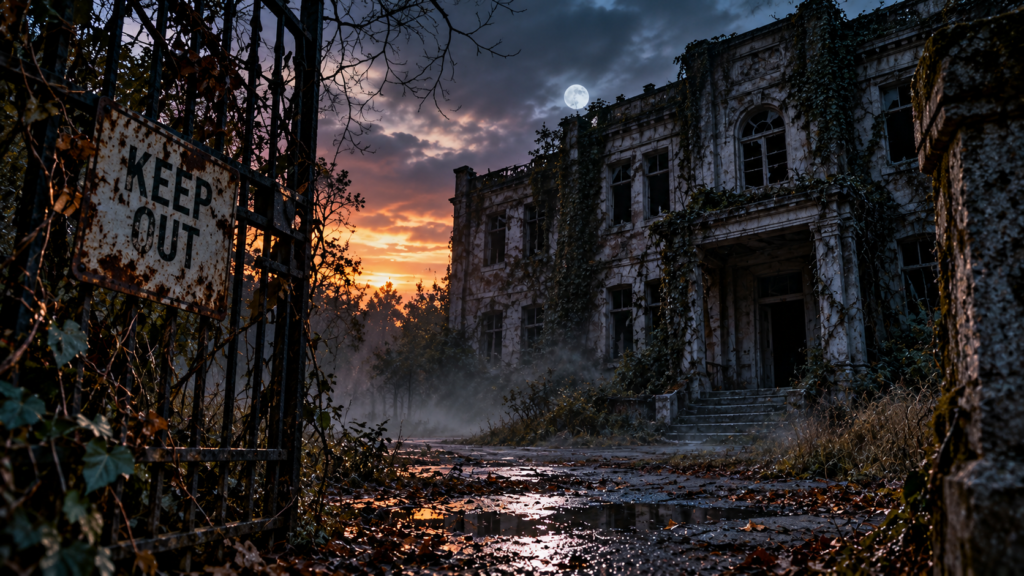
There are places in the world that people simply refuse to enter. Some are abandoned buildings slowly collapsing under the weight of time, while others are isolated stretches of forest, forgotten roads, or properties that have remained untouched for decades. Their reputations often develop through stories passed from one generation to the next, accounts of strange encounters, unexplained noises, and warnings from people who insist that something about the location isn’t right.
What makes these places particularly fascinating is that the fear surrounding them does not always begin with a documented tragedy or an extraordinary event. Sometimes, a building becomes unsettling simply because it has been abandoned for so long that nobody remembers what it was like when people still lived or worked there. Other locations develop darker reputations after someone reports an unusual experience, and as the story spreads, additional details may emerge until the original incident becomes difficult to separate from the folklore surrounding it.
The question is not simply whether these locations are haunted or dangerous. It is why certain places develop reputations so powerful that people avoid them even when there is little evidence of anything supernatural. Understanding that fear requires examining the relationship between human psychology, environmental conditions, local history, and the stories that communities preserve long after the original events have been forgotten.
When a Place Develops a Reputation
Imagine an old farmhouse standing at the end of a narrow dirt road. Its windows are broken, the roof has begun to sag, and weeds have overtaken what was once a carefully maintained yard. Nobody has lived there for years, and the surrounding property has slowly returned to nature. During the day, the building appears to be little more than an abandoned structure, but after sunset, the atmosphere changes. Shadows fill the empty windows, branches scrape against the siding, and the house seems isolated from everything around it.
Now imagine that someone in the nearby community claims to have seen a light moving through an upstairs room despite the building having no electricity. Another person remembers hearing footsteps while passing the property, and someone else recalls a story about the family who once lived there. Before long, the farmhouse becomes known as a place where unusual things happen, even though none of the accounts have been independently verified.
This is one way a location can develop a reputation that lasts for decades. As stories are repeated, details may change, disappear, or become exaggerated. New experiences are interpreted through the existing reputation, and ordinary events that might be ignored elsewhere suddenly seem significant. The house no longer represents an abandoned property alone. It becomes a place associated with mystery, uncertainty, and the possibility that something remains unexplained.
The Psychology of Entering an Unfamiliar Place
Human beings naturally evaluate their surroundings for potential danger, particularly when entering environments that are unfamiliar or difficult to navigate. Abandoned buildings often contain several features that can increase feelings of unease, including poor lighting, unfamiliar sounds, restricted visibility, and the possibility of hidden hazards. These conditions make it difficult to predict what might happen next, encouraging heightened awareness even when no immediate threat is visible.
When someone enters a location already associated with frightening stories, expectations can influence how ordinary sensory information is interpreted. A sudden noise may seem more threatening than it would in a familiar environment, while a shadow or reflection may be mistaken for movement. The person may become increasingly attentive to details that appear to support the location’s reputation, especially if they are already anticipating an unusual encounter.
This does not mean that every reported experience is imaginary. People can genuinely hear unexpected sounds, observe unfamiliar movements, or encounter environmental conditions they cannot immediately explain. The important distinction is between experiencing something unusual and determining what caused it. Fear can influence interpretation without necessarily creating the original observation, which is why careful investigation requires separating what someone experienced from what they believe the experience means.
Why Abandoned Buildings Feel Different
Buildings are designed around human activity. Homes contain the sounds of daily life, schools are filled with movement and conversation, and hospitals operate with a constant mixture of machinery, footsteps, and voices. When these activities disappear, the building may remain physically recognizable while feeling completely different from its original purpose. Empty corridors, unused rooms, and deteriorating furnishings create a powerful contrast between what the location once represented and what it has become.
Abandoned structures also produce sounds that can seem unusual to someone unfamiliar with their condition. Changes in temperature cause building materials to expand and contract, while wind can move through damaged windows, loose doors, ventilation openings, and gaps in the structure. Water may drip through deteriorating roofs, animals may occupy walls or ceilings, and unstable materials can shift or fall without warning. In a quiet environment, these sounds may become much more noticeable than they would have been when the building was occupied.
Lighting can further influence the experience. A flashlight moving through a dark room creates shifting shadows, while reflective surfaces may briefly resemble figures or movement. Dust, moisture, and uneven surfaces can alter visibility, making it difficult to judge distances or recognize objects. None of these conditions requires a paranormal explanation, but together they can create an atmosphere in which ordinary events become surprisingly unsettling.
The Influence of Local Folklore
Folklore plays an important role in shaping how communities remember certain locations. Stories about abandoned houses, isolated roads, old cemeteries, and forgotten buildings often survive long after the people associated with them are gone. Some accounts originate from documented historical events, while others develop through rumors, misunderstandings, or stories told primarily for entertainment. Over time, the distinction between history and legend can become increasingly difficult to establish.
A location associated with a tragedy may acquire stories about unexplained sounds, strange lights, or figures appearing near the property. Another place may become known for unusual activity simply because it has been avoided for generations. When children grow up hearing warnings about a particular building or stretch of road, those warnings can become part of the community’s identity, even if few people know where the original story began.
Folklore does not necessarily provide reliable evidence of paranormal activity, but it can reveal how people understand and respond to uncertainty. Stories often reflect local fears, historical experiences, and the desire to explain events that were poorly understood when they occurred. For investigators, understanding a location’s folklore can provide useful background information, provided that legends are not treated as established facts without independent support.
When Strange Sounds Become Part of the Story
One of the most common elements in reports involving abandoned locations is the presence of unusual sounds. Witnesses may describe footsteps in empty corridors, knocking behind walls, distant voices, or doors that appear to open and close without explanation. These experiences can be particularly unsettling because sound often provides information about activity occurring beyond our immediate field of vision. When the source cannot be identified, the mind may begin imagining possibilities that are more frightening than the actual cause.
Older buildings can produce a wide range of noises through ordinary physical processes. Heating and cooling affect wood, metal, and other construction materials, while changes in air pressure can move unsecured doors or create whistling sounds around openings. Wildlife may occupy attics, crawl spaces, and damaged sections of the structure, producing scratching, movement, or vocalizations that are difficult to identify from another room. Sound can also travel through connected spaces in unexpected ways, making a noise appear to originate somewhere other than its actual source.
However, recognizing possible explanations is not the same as determining which explanation applies to a particular event. Investigators must consider the timing, location, environmental conditions, and available recordings before drawing conclusions. A sound that cannot be immediately identified may justify further examination, but its unfamiliarity alone does not establish that something extraordinary occurred.
The Role of Darkness and Isolation
Darkness changes the way people experience familiar surroundings because it limits the amount of visual information available. Objects become harder to recognize, distances are more difficult to judge, and movement near the edge of our vision may appear ambiguous. In isolated environments, these limitations can be accompanied by an increased awareness of how far away assistance might be if something goes wrong.
An abandoned structure located in the middle of a populated neighborhood may feel unsettling, but a similar building several miles from the nearest road can create a different kind of anxiety. The person entering it may become more conscious of unfamiliar terrain, limited communication, and the possibility of encountering hazards without immediate assistance. These concerns are reasonable even when there is no evidence of paranormal activity.
The combination of darkness and isolation can also affect how an experience is remembered. An unexpected noise or sudden movement may produce a stronger emotional response when someone already feels vulnerable, making the event particularly memorable. This does not invalidate the person’s experience, but it demonstrates why the circumstances surrounding an encounter are important when evaluating what may have happened.
The Real Dangers Behind Abandoned Locations
While stories of ghosts and unexplained encounters attract attention, abandoned buildings can contain very real hazards that deserve greater concern than their paranormal reputations. Structural deterioration may leave floors, stairways, ceilings, and walls unstable, while exposed wiring, broken glass, unsecured openings, and deteriorating construction materials create additional risks. Some locations may contain hazardous substances, contaminated water, or poor air quality, particularly when the building previously served an industrial or medical purpose.
Underground spaces, tunnels, and abandoned mines can be especially dangerous because they may contain unstable ground, flooding, oxygen-deficient environments, or hazardous gases. A location that appears accessible from the outside may become difficult to navigate once inside, and damaged structures can collapse without obvious warning. These dangers are not always visible, making abandoned locations unsuitable for casual exploration without appropriate authorization and professional safety assessment.
There are also legal and ethical considerations. Many abandoned properties remain privately owned, and entering them without permission may constitute trespassing. Historical buildings may contain fragile materials or artifacts that should be preserved rather than disturbed. Curiosity about a location’s reputation does not justify placing people at risk or damaging property, and responsible investigation must begin with an understanding of the site’s condition, ownership, and potential hazards.
When Witnesses Report Something Unexplained
Not every account involving an abandoned location can be easily resolved through a simple explanation. Witnesses sometimes report seeing figures, hearing unfamiliar voices, or observing lights in places where they did not expect human activity. Some describe experiences that remain vivid years afterward, particularly when the incident occurred unexpectedly or involved circumstances they found difficult to understand.
These reports deserve careful consideration without automatically accepting a paranormal interpretation. Investigators may examine whether the location was accessible to other people, whether nearby roads or buildings could have produced reflected light, or whether environmental conditions affected visibility and sound. They may also compare independent witness accounts and review any available photographs, recordings, or physical evidence.
In some cases, the available information may be insufficient to determine what happened. A witness may have observed something genuine without obtaining enough detail to identify it, while changes to the location may prevent investigators from recreating the original conditions. An unresolved report should be documented accurately, but uncertainty must remain part of the conclusion rather than being replaced with an unsupported explanation.
How Fear Can Spread Through a Community
Once a location becomes associated with frightening experiences, its reputation can influence the behavior of an entire community. People may avoid walking past it after dark, warn visitors against approaching it, or interpret ordinary events nearby as further evidence that something unusual is occurring. Stories shared through conversations, local media, and online discussions can reinforce the reputation, sometimes introducing details that were absent from the original accounts.
This process can create a cycle in which expectations influence experiences and those experiences strengthen existing beliefs. Someone who hears that an abandoned house is haunted may approach it with heightened anxiety, making ordinary sounds or shadows seem more threatening. If the person later shares the experience, the account may become another part of the location’s growing collection of stories.
The resulting reputation can persist even when the building is demolished or the property changes ownership. In some communities, the location itself becomes less important than the story attached to it. A vacant lot may continue to be associated with events supposedly connected to a structure that no longer exists, demonstrating how strongly folklore can influence the way people remember places.
When History and Mystery Become Entangled
Some locations develop unsettling reputations because of their documented histories. Former hospitals, prisons, institutions, industrial facilities, and residences associated with significant events may attract curiosity long after their original purposes have ended. The knowledge that people experienced hardship, illness, isolation, or tragedy within a building can influence how visitors perceive it, even when there is no reliable evidence of paranormal activity.
Historical records can help distinguish documented events from later additions to a location’s folklore. Property records, newspapers, photographs, and firsthand accounts may establish who occupied a building, what occurred there, and how the location changed over time. These sources can also reveal that stories repeated as local history were exaggerated, misunderstood, or associated with the wrong property.
Understanding a location’s history does not eliminate the emotional impact it may have on visitors. An abandoned building can be unsettling because it represents lives, experiences, and activities that have disappeared from everyday memory. Sometimes the mystery lies not in an unexplained presence, but in the realization that a place once filled with people has become almost completely forgotten.
Investigating Locations With Unusual Reputations
Within the fictional universe of Z.E.R.O. — Zero Event Response Organization, a location’s frightening reputation alone would not establish that a paranormal incident had occurred. Reports involving abandoned buildings, isolated properties, or unexplained environmental activity would require an assessment of the available information before investigators could determine whether further examination was warranted.
An investigation might involve reviewing witness statements, examining historical records, assessing environmental conditions, and documenting physical evidence associated with the reported incident. Depending on the circumstances, specialized personnel could evaluate structural hazards, biological concerns, or other conditions that might affect the safety of those entering the location. The objective would be to understand what happened while avoiding unnecessary assumptions about the cause.
Some investigations might reveal ordinary explanations involving wildlife, environmental conditions, human activity, or misunderstood evidence. Others could remain unresolved because the available information was incomplete or unreliable. A smaller number might produce findings that require more extensive scientific examination, but the organization’s responsibility would remain the same: evaluate the evidence carefully and distinguish verified observations from speculation.
The existence of a frightening story would not make a location paranormal, just as the absence of an immediate explanation would not prove that something extraordinary had occurred. A credible investigation would depend on what could actually be documented, tested, and reasonably established.
Why Some Places Remain Feared for Generations
One of the most fascinating aspects of locations with unsettling reputations is how long those reputations can survive. Buildings deteriorate, ownership changes, roads are rerouted, and entire communities evolve, yet certain places continue to be associated with stories that began decades earlier. Sometimes the original witnesses are no longer alive, and the accounts that remain have passed through so many people that their earliest details can no longer be verified.
The persistence of these stories reveals something important about human nature. People are drawn to mysteries, particularly those involving places that seem separated from ordinary life. An abandoned house, an overgrown cemetery, or a forgotten road offers an environment where imagination can fill gaps left by incomplete knowledge. The less people know about a location, the easier it may become for uncertainty to develop into a lasting legend.
Fear can also serve a practical purpose within communities. Warnings about unstable buildings, dangerous terrain, or isolated properties may discourage people from entering locations where genuine hazards exist. Over time, those warnings may become intertwined with supernatural stories, making it difficult to determine whether the original concern involved a real danger, an unexplained event, or simply an effort to keep people away from an unsafe place.
The Mystery May Be More Human Than Paranormal
The mystery surrounding places people refuse to enter is not always found inside the buildings or hidden among the trees. Sometimes it exists in the stories people tell, the expectations they carry, and the emotional reactions created by unfamiliar environments. An abandoned location can feel threatening without containing anything extraordinary, just as an unexplained experience can remain meaningful to a witness without providing evidence of a supernatural cause.
This does not make the subject any less fascinating. Understanding why certain locations inspire fear reveals how human perception, memory, history, and folklore interact. It also demonstrates why responsible investigation requires more than curiosity or a willingness to enter somewhere others avoid. The investigator must be prepared to question assumptions, examine ordinary explanations, and acknowledge when the available evidence cannot support a definitive conclusion.
Perhaps that is why these places continue to capture our imagination. They remind us that uncertainty can be powerful, particularly when it surrounds something that was once familiar but has become forgotten. An empty building, a silent road, or an abandoned property may contain nothing more mysterious than the passage of time, yet the atmosphere can still make someone hesitate before approaching.
And sometimes, the most interesting question isn’t whether something is waiting inside. It’s why so many people have become convinced that entering would be a mistake.
Ginger Yarbrough
Creator and Author of Z.E.R.O. — Zero Event Response Organization