When the Evidence Tells Two Different Stories
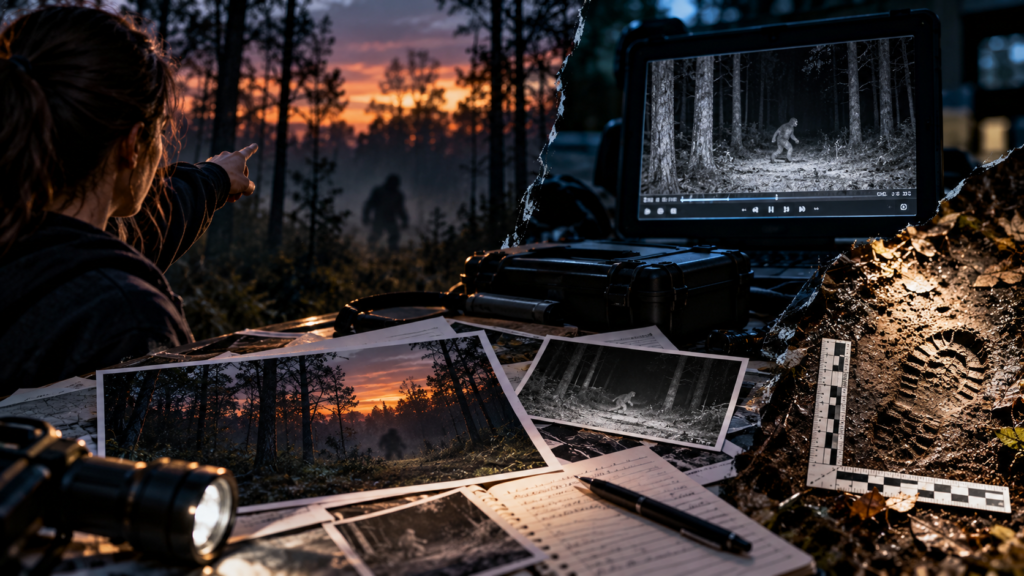
Sometimes, the greatest mystery in an investigation isn’t what happened. It’s why the evidence seems to tell two completely different stories. An eyewitness may describe an extraordinary encounter with absolute certainty, while the physical evidence collected afterward suggests something entirely different. Both sources of information may appear credible, yet investigators are left trying to understand how two seemingly contradictory accounts could emerge from the same event.
Imagine standing in a quiet wooded area where an unusual incident was reported the previous evening. A witness insists that a large, unidentified figure crossed a clearing shortly after sunset. According to the account, the figure moved quickly, appeared unusually tall, and disappeared into the surrounding trees without making a sound. The witness is visibly shaken and remains convinced of what was seen, describing the encounter with confidence and providing details that seem consistent with a genuine experience.
But investigators examining the clearing discover something unexpected. The available physical evidence doesn’t seem to support the witness’s description. There are no obvious tracks where the figure supposedly crossed, and a nearby security camera captured movement that appears considerably smaller than the witness described. The discrepancy raises questions that cannot be answered simply by accepting one source of information and rejecting the other.
Should investigators trust the person who witnessed the event, or the evidence collected afterward? What happens when both appear credible but point toward different conclusions? The answer is rarely as simple as choosing one and dismissing the other, because understanding an incident requires examining not only what the evidence suggests, but also how that evidence was obtained and interpreted.
Eyewitness Testimony Is Important, but Human Memory Has Limitations
Eyewitness accounts have played an important role in investigations throughout history. People can provide information about events that were never photographed, recorded, or otherwise documented, and their observations may help establish timelines, identify locations, or direct investigators toward evidence they might otherwise overlook. A witness may remember a particular sound, an unusual movement, or the direction in which someone traveled, providing details that become valuable when compared with other findings.
However, human memory does not function like a video recording. When someone witnesses an unexpected event, the brain processes information under the conditions present at that moment. Lighting, distance, movement, stress, distractions, and the duration of the encounter can all affect what a person perceives. Later, when the individual recalls the event, those memories may be influenced by additional information, conversations, expectations, or the natural reconstruction involved in remembering past experiences.
This doesn’t necessarily mean the witness is lying. A person can sincerely believe every detail of an account while being mistaken about certain aspects of what happened. Consider someone who sees an unfamiliar shape moving between trees at dusk. The person may correctly remember that something crossed the clearing but misjudge its size or distance because of poor lighting and limited visual references. The original observation may be genuine even when the interpretation is inaccurate, making it important to distinguish between what someone actually observed and what they concluded from that observation.
Physical Evidence Has Limitations Too
It is tempting to assume that physical evidence always provides a more reliable account than human testimony. Photographs, recordings, measurements, and recovered objects appear less vulnerable to the uncertainty associated with memory, and they can preserve information that might otherwise disappear. However, physical evidence must also be interpreted, and the circumstances surrounding its collection can significantly affect what investigators are able to determine.
A photograph captures only what was visible within the camera’s frame at the moment the image was taken. It does not automatically explain what happened before or afterward, nor does it necessarily provide accurate information about an object’s true size or distance. Lighting, lens distortion, exposure settings, motion blur, and environmental conditions can influence how objects appear. Video recordings introduce additional complications, including compression artifacts, low frame rates, poor resolution, and limited camera angles that may create misleading impressions of movement or shape.
Even physical traces such as footprints require careful examination. A track found in soft mud may appear larger or differently shaped than the foot or object that produced it, while rain, erosion, overlapping impressions, and changes in the ground can alter evidence before investigators arrive. Scientific instruments have limitations as well, since measurements may be affected by calibration, interference, operating conditions, or the way equipment is used. The existence of a photograph, recording, or measurement does not automatically establish that its interpretation is correct, and reliable conclusions require understanding the conditions under which the evidence was obtained.
When Two Witnesses Remember Different Events
One of the more challenging situations occurs when multiple people witness the same incident but provide conflicting accounts. Imagine two individuals standing near a roadway when an unfamiliar object passes overhead. One describes a bright white light moving rapidly across the sky, while the other remembers a dull orange glow traveling much more slowly. Both were present at approximately the same time, and both insist their observations are accurate, creating an apparent contradiction that investigators must carefully examine.
Several ordinary factors could explain the differences. The witnesses may have viewed the object from different angles, with one looking directly toward the light while the other observed it through branches or against a brighter section of sky. Their attention may have been focused on different details, and the duration of their observations may not have been identical. Human perception of speed and distance can also be unreliable when an object’s actual size and location are unknown, particularly when there are few recognizable reference points.
Two witnesses can therefore describe the same event differently without either person intentionally providing false information. Investigators must consider what each individual was positioned to observe, how long the event lasted, and whether their accounts were recorded independently before they had an opportunity to influence one another. The goal is not simply to decide which witness sounds more convincing, but to determine which details can be supported by additional evidence and which remain uncertain.
The Problem With Confidence
People often associate confidence with accuracy, especially when evaluating eyewitness testimony. A witness who speaks clearly, maintains a consistent account, and expresses certainty may appear more credible than someone who hesitates or admits uncertainty. Yet confidence alone does not establish that a memory is accurate, and a person’s certainty may change as they repeatedly discuss an event or encounter information that reinforces their interpretation.
A person may become increasingly confident in an account after hearing others describe similar experiences, even when the additional information was not part of the original observation. Conversely, someone who provides a cautious account may actually be demonstrating an appropriate awareness of what could and could not be observed. A witness who acknowledges uncertainty about distance, size, or identity may offer investigators a more useful description than someone who immediately assigns a definite explanation to an unfamiliar event.
Consider an individual who declares that an unidentified object was unquestionably a spacecraft from another world. Another witness might simply report seeing a large illuminated object above the trees while acknowledging that its distance, size, and origin could not be determined. The second account separates observation from interpretation, allowing investigators to evaluate the available details without first accepting an unsupported conclusion. Recognizing this distinction is essential to careful investigative work, particularly when an incident involves something unfamiliar or difficult to explain.
When the Evidence Appears to Contradict Itself
Conflicting evidence doesn’t always involve witnesses. Sometimes, different forms of physical evidence appear inconsistent with one another, creating questions that cannot be resolved through a simple comparison. A camera may record movement in an area where motion sensors report no activity, an audio recording may capture a loud sound that nearby witnesses insist they never heard, or a recovered material may produce one result during an initial examination and a different result under controlled laboratory conditions.
Such inconsistencies can be frustrating, particularly when investigators expect independent sources to confirm one another. However, contradictions can also reveal important information about the limitations of the evidence. A motion sensor may fail to detect movement outside its coverage area or under conditions that reduce its sensitivity, while a microphone may record sounds that were masked by other noise or difficult for a person to notice. The absence of a corresponding observation does not necessarily mean the original recording was inaccurate.
Laboratory findings may also differ because samples were collected from different portions of a material, exposed to different conditions, or analyzed using methods that measure different properties. Before concluding that an event defies explanation, investigators must establish whether the evidence is genuinely contradictory or whether the apparent conflict results from differences in collection, measurement, or interpretation. Sometimes the disagreement disappears once those circumstances are understood, while other cases require additional testing before a reliable conclusion can be reached.
The Danger of Choosing an Explanation Too Early
Every investigator brings knowledge, experience, and expectations into an examination. Those qualities can be valuable because they help investigators recognize familiar patterns, identify potential sources of evidence, and determine which questions deserve attention. However, they can also create problems when an early theory begins influencing how later evidence is interpreted, especially if the investigator becomes reluctant to consider information that challenges an initial conclusion.
This is commonly associated with confirmation bias, the tendency to favor information that supports an existing belief while giving less attention to contradictory findings. An investigator who believes an unusual event was caused by an animal may focus primarily on tracks, wildlife activity, and natural explanations, while another who immediately suspects something extraordinary may interpret ambiguous recordings or unfamiliar marks as confirmation of that possibility. Both approaches can become problematic when the investigator stops considering alternative explanations or dismisses evidence that does not fit the preferred theory.
A sound investigative process requires a willingness to revise an initial explanation as new information becomes available. Evidence that contradicts a preferred conclusion should not be ignored simply because it complicates the investigation, and investigators must remain prepared to acknowledge when their assumptions were incorrect. In fact, contradictory findings may be among the most valuable discoveries in a case because they force investigators to reconsider what they think they know and examine possibilities that might otherwise have been overlooked.
Why the Smallest Details Can Change Everything
Sometimes, the difference between two conflicting accounts comes down to a detail that initially seems insignificant. A witness may report seeing a figure beside a building, while a photograph suggests the figure was much shorter than described. Further examination might reveal that the witness observed the scene from a lower elevation, making the figure appear taller against the structure. What initially seemed like a contradiction could therefore result from differences in perspective rather than an inaccurate or dishonest account.
A strange light captured on video may seem to move independently until investigators discover that the camera shifted slightly during the recording. An apparent absence of footprints may become less mysterious when the ground conditions are examined, revealing that a hard surface, fallen leaves, or later weather changes could explain why no clear impressions were preserved. These details do not necessarily resolve every case, but they demonstrate why careful observation and an understanding of environmental conditions matter.
An investigation can change direction because someone notices a reflection, examines a timestamp, questions an assumption, or returns to the original location to compare perspectives. The most dramatic evidence is not always the most informative, and an ordinary detail may provide more useful information than an unusual photograph or sensational witness description. Sometimes the answer lies in something everyone initially overlooked, waiting to be recognized during a more careful examination of the available evidence.
The Importance of Independent Verification
When evidence points in different directions, independent verification becomes especially valuable. Investigators may seek additional recordings, compare environmental measurements, examine physical materials using different methods, or interview witnesses separately to reduce the possibility of their accounts influencing one another. They may also attempt to recreate relevant conditions, allowing them to determine whether an ordinary explanation could produce observations similar to those originally reported.
For example, if a witness describes an unusually large figure moving through a clearing, investigators might return at a comparable time of day to examine lighting, distance, and available visual references. If a recording shows an unexplained flash, they may evaluate possible reflections, electrical activity, weather conditions, or nearby sources of illumination. These efforts are not intended to force evidence into a predetermined explanation, but to determine which interpretations remain plausible after careful examination.
Independent verification also helps reduce reliance on a single observation or instrument. A finding supported by multiple reliable sources is generally more informative than one that depends entirely on an isolated, ambiguous recording, particularly when those sources were obtained independently. Even when several sources appear to agree, however, investigators must consider whether they share common limitations or were influenced by the same underlying conditions. Reliable conclusions should reflect both the strength of the available evidence and the uncertainty that remains.
When the Investigation Involves the Unexplained
Within the fictional world of Z.E.R.O. — Zero Event Response Organization, investigators may encounter reports involving unfamiliar phenomena, unusual biological findings, or incidents that appear inconsistent with ordinary explanations. In such situations, conflicting evidence would present an especially important challenge because the organization must evaluate unfamiliar possibilities without abandoning the investigative standards necessary to reach reliable conclusions.
A witness might describe an extraordinary encounter while the physical evidence suggests a more conventional possibility. Alternatively, investigators might recover material that raises questions not adequately addressed by the original witness account. Neither situation would justify immediately accepting or dismissing the reported event, and the organization would need to examine the available information, evaluate the reliability of each source, and determine whether additional investigation was warranted.
Not every unusual report would necessarily involve a genuine anomaly. Some incidents might ultimately have natural explanations, while others could remain unresolved because important information was missing or the available evidence was insufficient. A smaller number might present findings that genuinely challenge the investigators’ understanding, requiring additional research or specialized examination. The distinction matters because an organization investigating the unexplained cannot approach every case assuming that something paranormal must be responsible, but it also cannot dismiss unusual findings simply because they do not fit an expected explanation.
What Happens When No Explanation Fits?
Not every investigation ends with a satisfying conclusion. Sometimes, witnesses provide accounts that cannot be independently confirmed, physical evidence may be incomplete, recordings may lack sufficient detail, or environmental conditions may have changed before investigators arrive. In other cases, several reasonable explanations remain possible, but none can be established with confidence because the available information does not adequately distinguish between them.
The result may be an unresolved case, but that does not mean the investigation failed. A responsible conclusion can acknowledge uncertainty without inventing an answer, and there is an important difference between determining that something extraordinary occurred and determining that the available information is insufficient to explain an event. An unexplained incident is not automatically evidence of a paranormal cause; it is an incident for which a satisfactory explanation has not yet been established.
Sometimes additional evidence becomes available later, allowing investigators to reconsider earlier findings. New technology, improved analytical methods, or previously unknown information may provide answers that were not possible during the original investigation. Other cases may remain unresolved indefinitely, particularly when essential evidence was never collected or cannot be recovered. Although uncertainty can be frustrating, acknowledging those limitations is preferable to presenting an unsupported conclusion as fact.
Two Stories, One Truth
When eyewitness testimony and physical evidence appear to contradict each other, the temptation is to assume that one must be correct and the other must be wrong. But investigations are rarely that simple, and different sources of evidence may reveal different portions of the same event. A witness may accurately describe part of an incident while misunderstanding another detail, a photograph may be authentic yet misleading because of perspective or lighting, and an instrument may function correctly while producing a reading that is interpreted incorrectly.
The challenge is determining how those pieces fit together. Sometimes the contradictions can be resolved through careful examination, while other times they reveal weaknesses in the original assumptions or leave investigators with more questions than answers. The most important quality an investigator can possess is not the ability to produce an immediate explanation, but the willingness to keep examining the evidence when the answer remains uncertain.
Because the purpose of an investigation is not to prove that a witness was right, that a theory was correct, or that something extraordinary happened. It is to discover what the evidence can genuinely establish, even when the findings challenge expectations or lead toward an unexpected conclusion. And when two pieces of evidence seem to tell different stories, the truth may be waiting in the details neither one reveals on its own.
Ginger Yarbrough
Creator and Author of Z.E.R.O. — Zero Event Response Organization