Remembering Mass Effect: More Than Just a Video Game
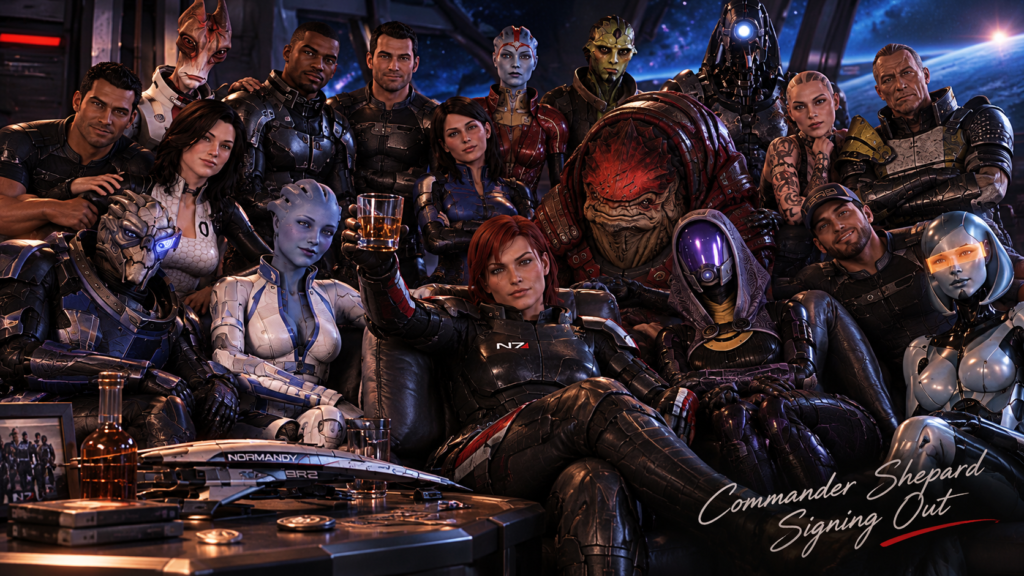
Some stories stay with us long after the final credits roll. Mass Effect is one of them.
There are video games you play, enjoy, and eventually forget. Then there are games that become part of your memories, leaving behind characters, conversations, and moments that stay with you for years. For me, Mass Effect belongs in that second category.
When BioWare introduced Commander Shepard and the crew of the Normandy in 2007, it gave players something extraordinary. It wasn’t simply another science-fiction adventure about saving the galaxy. It was a universe filled with complicated relationships, difficult decisions, unforgettable personalities, and consequences that followed you from one game to the next.
You weren’t just watching Commander Shepard’s story unfold. You were helping shape it.
A Galaxy That Felt Alive
One of Mass Effect’s greatest achievements was making an enormous fictional universe feel believable. Every alien civilization had its own history, political struggles, traditions, and prejudices. Humanity was relatively new to the galactic community, and not everyone was particularly thrilled to have us around.
The Citadel was more than a location where you accepted missions. It was a place where different species lived, worked, argued, and tried to coexist. The Normandy was more than a spaceship. It became a home, filled with people you gradually came to know and care about.
Exploring distant planets, discovering ancient civilizations, uncovering mysteries, and confronting threats that seemed impossible to defeat created a sense of wonder that few games have managed to duplicate.
And then there were the Reapers.
Mass Effect introduced an enemy that was genuinely terrifying, not simply because of its size or destructive capabilities, but because of what it represented. An ancient intelligence capable of wiping out entire civilizations, repeating the process across countless generations, and leaving almost nothing behind.
The deeper you ventured into the story, the more you realized just how much was at stake.
The Crew We Never Forgot
Ask longtime Mass Effect players what they remember most, and many will immediately start naming characters.
Garrus Vakarian, the loyal turian who could always be counted on when things went sideways. Tali’Zorah, whose intelligence, determination, and personal struggles made her one of the most memorable members of the crew. Liara T’Soni, whose journey from a curious young archaeologist to a powerful information broker was remarkable.
Then there was Wrex, whose rough personality concealed a complicated history and a fierce determination to secure a future for his people. Joker brought humor to even the darkest situations, while EDI challenged what it meant to be alive.
And who could forget Mordin Solus?
Some characters made us laugh. Others frustrated us. A few broke our hearts.
What made these relationships special was that they developed over time. You could disagree with your companions, earn their loyalty, discover their pasts, and sometimes influence their futures. They weren’t simply standing around waiting for the next mission. They had their own problems, beliefs, regrets, and hopes.
By the time the trilogy reached its conclusion, losing one of them could feel surprisingly personal.
That is what exceptional character writing can accomplish.
The Weight of Our Decisions
Mass Effect also understood something important about storytelling: choices become meaningful when they carry consequences.
Sometimes those decisions were obvious. Other times, there was no comfortable answer.
You might have to choose between saving one person and sacrificing another. You could attempt to resolve generations of hatred between entire species or make decisions that would permanently change their futures.
And occasionally, despite your best intentions, things went terribly wrong.
The brilliance of the trilogy was that many decisions followed you into later games. Characters remembered what you had done. Relationships changed. Entire storylines could unfold differently depending on choices made hours, or even years, earlier.
Not every consequence was perfectly handled, and players certainly had their disagreements about how the trilogy ended. But the experience of carrying your own Commander Shepard through three interconnected adventures was something special.
It made the story feel like yours.
The Moments That Stayed With Us
Every Mass Effect fan probably has a collection of moments they will never forget.
The first time Sovereign revealed the true nature of the Reapers. The desperate suicide mission through the Omega-4 Relay. The emotional reunions, unexpected betrayals, and heartbreaking sacrifices.
There were moments of genuine fear, moments of triumph, and moments when you simply sat staring at the screen, trying to process what had happened.
But not everything memorable involved saving the galaxy.
Sometimes it was a conversation aboard the Normandy. A sarcastic remark from a companion. A quiet exchange between missions. Or the wonderful absurdity of the Citadel DLC, which gave us a chance to enjoy these characters as friends rather than soldiers constantly facing extinction.
Those smaller moments mattered just as much as the enormous battles.
They reminded us what Shepard was fighting to protect.
Commander Shepard Was Our Commander
Perhaps the most remarkable thing about Mass Effect was how personal Commander Shepard became to the player.
We could choose Shepard’s appearance, background, personality, relationships, and approach to difficult situations. Some players preferred a diplomatic Paragon, while others embraced the ruthless efficiency of a Renegade.
Many of us played the trilogy more than once, experimenting with different decisions or simply returning to the version of Shepard we had grown attached to.
And although the destination might have been similar, the journey was never quite the same.
Commander Shepard became more than a character on a screen. Shepard represented the choices we made, the friendships we valued, and the kind of leader we wanted to be.
That connection is difficult to reproduce, and it helps explain why so many players continue to revisit the trilogy.
Why Mass Effect Still Matters
Video games have changed enormously since the original Mass Effect was released. Graphics have improved, worlds have grown larger, and technology has made experiences possible that once seemed unimaginable.
Yet better technology doesn’t automatically create better storytelling.
Mass Effect proved that players could become deeply invested in fictional people and places when writers took the time to develop them. It demonstrated the importance of meaningful dialogue, believable relationships, moral complexity, and a world that existed beyond the immediate needs of the main character.
It also showed that science fiction could explore very human questions.
What makes someone alive? Can centuries of hatred ever truly be overcome? Is survival worth any sacrifice? How much responsibility should one person carry when the lives of millions depend on their decisions?
These questions gave the trilogy a depth that went far beyond combat and exploration.
For those of us who love science fiction and storytelling, that is part of what made Mass Effect extraordinary.
One Last Trip Aboard the Normandy
There is something bittersweet about returning to a game you have already finished. You know the characters. You remember the major events. You know that eventually the adventure will come to an end.
But you return anyway.
Maybe it’s because you miss the Normandy. Maybe you want to hear Garrus make another sarcastic comment, visit Tali, talk to Liara, or listen to Joker complain about something.
Maybe you simply want to stand on the bridge again, looking out into a galaxy filled with possibilities.
Whatever the reason, Mass Effect has earned its place among the stories that refuse to fade from memory.
The trilogy wasn’t flawless. No great story is. But its imperfections never erased what it accomplished or the emotional connection so many players developed with its characters.
Years later, we still remember the missions, the friendships, the sacrifices, and the impossible decisions.
We remember the Normandy.
We remember the crew.
And most of all, we remember Commander Shepard.
Some adventures end when the credits roll. Others stay with us for a lifetime.
Commander Shepard, signing off.
Ginger Yarbrough