The Technology Behind Z.E.R.O.
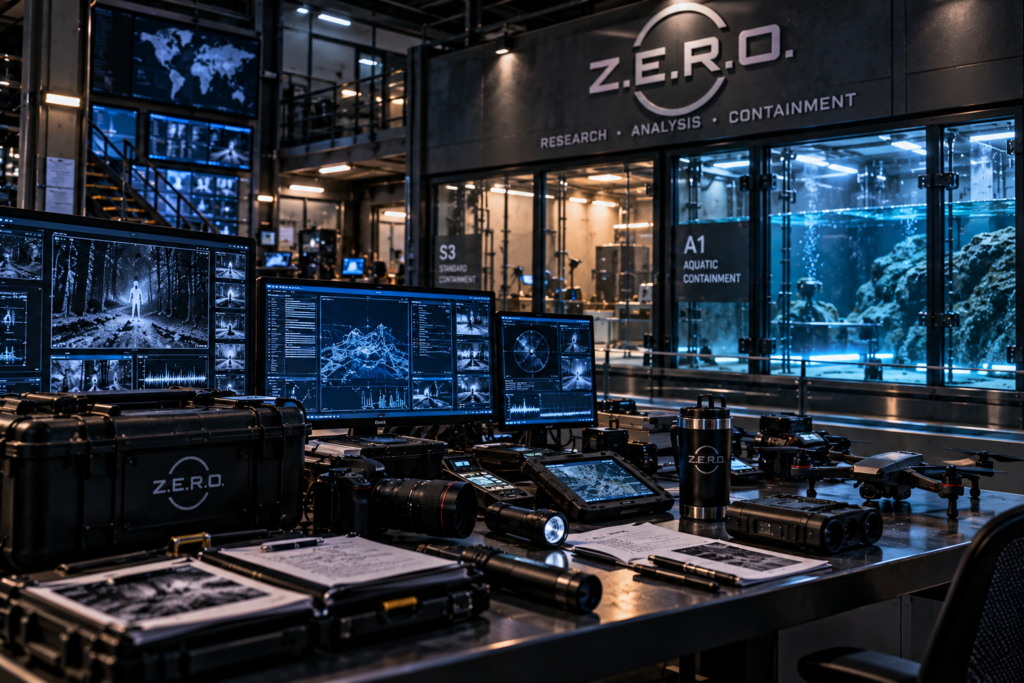
Investigating the impossible requires more than extraordinary equipment. It requires the ability to recognize, measure, and understand what conventional science has yet to explain.
Technology has transformed the way humanity investigates the world around us. Instruments can detect radiation invisible to the human eye, reveal structures hidden beneath the Earth’s surface, analyze microscopic biological material, and monitor environmental conditions with remarkable precision.
But what happens when those instruments encounter something they were never designed to measure?
What happens when an unknown organism displays characteristics that contradict established biological classifications? When an unexplained event produces physical evidence that researchers cannot identify? Or when sophisticated monitoring systems capture information that challenges conventional explanations?
Within the fictional universe of Z.E.R.O. — Zero Event Response Organization, technology provides the foundation for investigating these extraordinary possibilities.
The organization combines established scientific principles with specialized equipment, research facilities, and technical expertise to examine phenomena that may fall beyond current scientific understanding.
However, technology alone cannot provide every answer.
The true challenge lies in determining what the instruments are detecting, whether the information can be verified, and how those discoveries might expand our understanding of the unknown.
Technology With a Purpose
One of the most important principles behind Z.E.R.O.’s technological capabilities is that equipment must serve a practical investigative purpose.
Advanced technology is not valuable simply because it appears impressive or futuristic. Its usefulness depends on whether it can collect reliable information, improve operational safety, support scientific research, or solve a specific problem.
An investigator examining an unusual environmental disturbance may require specialized monitoring equipment. A researcher studying an unidentified biological specimen may need controlled laboratory conditions and sophisticated analytical instruments.
An operation involving a potentially dangerous organism presents an entirely different set of challenges.
Within Z.E.R.O., the equipment used during an investigation must be appropriate to the circumstances.
This approach also reflects an important reality of scientific research: instruments are developed to measure specific properties under particular conditions.
When the nature of a phenomenon remains unknown, determining which instruments are appropriate can become an investigation of its own.
Field Investigation Technology
Field investigators are often the first personnel to encounter evidence of an unusual event.
Their responsibilities may include documenting the scene, interviewing witnesses, collecting physical evidence, assessing environmental conditions, and identifying potential hazards.
Modern investigative tools provide a starting point for these activities.
High-resolution cameras can preserve visual details that might otherwise be overlooked. Body-worn recording systems can document an investigator’s observations and movements. Thermal imaging equipment can identify differences in apparent surface temperature, while environmental sensors can monitor measurable changes in surrounding conditions.
Portable communication systems allow personnel to coordinate their activities and exchange information with other investigators.
But even reliable equipment has limitations.
A camera may capture an unfamiliar shape without providing enough detail for identification. A thermal image may reveal an unusual temperature pattern without establishing its cause.
An environmental sensor may register a change that results from interference rather than an extraordinary phenomenon.
For Z.E.R.O., these limitations make careful documentation and scientific interpretation essential.
The objective is not simply to collect unusual readings.
It is to determine what those readings actually mean.
Surveillance and Observation Systems
Observation plays an important role in understanding unfamiliar phenomena.
Some events occur too quickly for investigators to document manually. Others may take place repeatedly over extended periods, making continuous monitoring more practical than direct observation.
Surveillance technology allows researchers to gather information while reducing the need for personnel to remain physically present.
Within Z.E.R.O., monitoring systems support security operations, scientific observation, and the examination of environments where direct access may be difficult or unsafe.
Depending on the circumstances, cameras and sensors can help document movement, changes in environmental conditions, and activity occurring within designated observation areas.
However, surveillance footage must be interpreted carefully.
Camera positioning, lighting, image compression, reflections, and equipment limitations can affect the information recorded.
Even a clear recording may reveal only part of an event.
For this reason, investigators must consider multiple sources of information rather than relying on a single camera angle or isolated observation.
A recording may establish that something occurred.
Understanding what occurred can require considerably more investigation.
Scientific Laboratories and Analytical Equipment
Some discoveries cannot be adequately examined in the field.
Unknown biological samples, unusual materials, and unexplained physical evidence may require specialized laboratory analysis under controlled conditions.
Z.E.R.O.’s research facilities provide the resources necessary for more extensive scientific examination.
In conventional scientific research, laboratory instruments can help identify chemical compositions, examine microscopic structures, analyze biological characteristics, and measure physical properties.
Different techniques provide different types of information.
Microscopy can reveal structures too small to observe with the naked eye. Chemical analysis can help identify the substances present within a sample. Imaging technology may reveal internal features without requiring immediate dissection or destructive examination.
Yet even sophisticated instruments cannot guarantee that an unfamiliar specimen will fit an established classification.
A sample may display unexpected characteristics or produce results that require further testing.
In those circumstances, researchers must evaluate whether the findings reflect a genuinely unfamiliar property, an experimental limitation, contamination, or an error in measurement.
Within Z.E.R.O., scientific research is not simply about discovering something extraordinary.
It is about developing a reliable understanding of what has been discovered.
Containment Engineering
One of the most specialized technological responsibilities within Z.E.R.O. involves the containment of unfamiliar organisms and potentially hazardous discoveries.
Ordinary laboratory environments may not provide adequate protection when the physical capabilities, biological requirements, or environmental tolerances of a specimen remain unknown.
For this reason, Z.E.R.O. maintains dedicated containment facilities designed for different research and security requirements.
These include chambers of varying sizes, aquatic containment environments, and specialized temperature-controlled facilities.
Each type presents different engineering challenges.
Aquatic containment requires attention to water conditions, structural pressure, and the biological needs of organisms adapted to submerged environments.
Cold containment environments depend on reliable temperature regulation and appropriate thermal insulation.
High-temperature containment introduces different concerns involving heat resistance, environmental stability, and personnel safety.
The purpose of these systems extends beyond restricting movement.
A properly designed containment environment must support scientific observation while reducing unnecessary risk to personnel, the surrounding environment, and the specimen itself.
And because the characteristics of an unfamiliar organism may not be fully understood, containment requirements can change as research progresses.
Robotics and Artificial Intelligence
Robotics represents another important technological field within the Z.E.R.O. universe.
In real-world applications, robotic systems are used in manufacturing, medicine, scientific exploration, hazardous-material handling, and environments where direct human access may be dangerous.
These systems demonstrate how mechanical engineering, electronics, computer science, and software can work together to accomplish increasingly complex tasks.
Artificial intelligence adds another dimension by allowing certain computer systems to recognize patterns, process information, and assist with decisions within defined operational limits.
However, artificial intelligence is not automatically equivalent to human understanding or consciousness.
A system capable of analyzing information may still lack the broader judgment, adaptability, or awareness associated with human intelligence.
Within Z.E.R.O., robotics and artificial intelligence are especially significant because of the organization’s work involving advanced technological development.
One of the most distinctive elements of this fictional universe is Ben, an android whose existence introduces possibilities extending beyond ordinary investigative equipment.
His presence also creates opportunities to explore the relationship between technology, identity, intelligence, and human interaction.
These subjects are not limited to engineering.
They raise questions about what it means to think, communicate, learn, and exist alongside people.
And they demonstrate how technological development can influence the human relationships at the center of the Z.E.R.O. universe.
Communications and Operational Coordination
An organization investigating unusual events across different environments must be capable of coordinating personnel, equipment, and information.
Communication systems are essential to this process.
Field teams may need to exchange observations with researchers, report changing conditions, request assistance, or transmit information for further analysis.
Remote locations introduce additional difficulties.
Mountainous terrain, dense forests, underground structures, and physical barriers can interfere with conventional communication technologies.
Even sophisticated systems may experience limitations depending on distance, environmental conditions, and available infrastructure.
Within Z.E.R.O., reliable communication supports both investigative efficiency and personnel safety.
It also allows different departments to contribute their expertise without requiring every specialist to be physically present at an investigation site.
An unusual discovery may begin with a field observation, but understanding it can require the combined efforts of investigators, researchers, engineers, and technical personnel.
Effective communication helps connect those efforts.
Transportation and Mobile Operations
Technology does not exist solely inside laboratories and research facilities.
Some investigations require specialized transportation and logistical support to reach remote or difficult environments.
Z.E.R.O.’s operational resources include vehicles, aircraft, boats, and other transportation equipment suited to different investigative requirements.
These resources allow personnel to move equipment, reach investigation sites, and respond to circumstances that may be difficult to manage using ordinary transportation.
A remote wilderness investigation may require different logistical planning from an operation involving a waterway or isolated industrial location.
Transporting delicate scientific instruments also presents practical challenges.
Equipment must be protected from vibration, moisture, temperature changes, and other environmental conditions that could affect its performance.
Recovered evidence may require additional precautions during transportation, particularly when its biological or chemical properties remain uncertain.
Within Z.E.R.O., transportation is therefore more than a means of reaching an investigation.
It is part of the infrastructure that allows scientific and investigative operations to function.
Data Collection and Information Analysis
Scientific investigations often produce large amounts of information.
Photographs, environmental measurements, witness statements, laboratory results, surveillance recordings, and other forms of documentation may all contribute to understanding a single event.
Organizing that information is essential.
Computer systems can assist researchers in storing records, comparing observations, examining patterns, and identifying inconsistencies that require further attention.
However, large amounts of data do not automatically produce reliable conclusions.
Information may be incomplete, incorrectly labeled, duplicated, or affected by measurement errors.
Patterns can also appear meaningful even when they result from coincidence.
Within Z.E.R.O., careful analysis is necessary to distinguish potentially significant observations from misleading correlations.
An unusual pattern may justify additional research.
It does not necessarily establish a connection between separate events.
The quality of an investigation depends not only on how much information is collected, but also on how responsibly that information is evaluated.
When Technology Reaches Its Limits
Perhaps the most interesting aspect of investigating the unknown is recognizing that even advanced technology has limitations.
Scientific instruments are designed according to existing knowledge of physical properties, biological processes, and measurable phenomena.
When something unfamiliar is encountered, researchers may discover that their equipment cannot provide all the information they need.
A sensor may fail to register a phenomenon that investigators can observe directly. An unfamiliar material may behave unpredictably during testing. An organism may display characteristics that existing analytical methods cannot adequately explain.
These situations do not automatically mean that the phenomenon violates the laws of physics.
They may indicate that the equipment is unsuitable, the measurements are incomplete, or the underlying process is not yet understood.
For Z.E.R.O., such challenges create opportunities for further investigation and technological development.
Sometimes the answer may involve adapting existing equipment.
Other situations may require entirely different approaches to observation and measurement.
Scientific progress often begins when researchers recognize the limitations of what they currently know.
The Human Element Behind Advanced Technology
Despite the organization’s specialized equipment and scientific resources, technology remains dependent on the people responsible for using it.
Investigators must decide what evidence is relevant. Researchers must evaluate experimental results. Engineers must recognize design limitations and develop practical solutions.
A sophisticated instrument cannot replace experience, curiosity, professional judgment, or ethical responsibility.
And technology does not eliminate the emotional consequences of confronting something extraordinary.
An investigator may still experience fear. A scientist may struggle to understand a discovery. A technical specialist may face the frustration of developing a solution without knowing whether it will work.
These human experiences are just as important as the equipment itself.
Within Z.E.R.O., technology supports the people conducting investigations.
It does not replace them.
Building Technology for an Uncertain Future
The technological capabilities of Z.E.R.O. reflect the challenges of operating in a world where unfamiliar phenomena may require unfamiliar solutions.
Field equipment provides the first observations. Surveillance systems preserve information. Laboratories allow researchers to examine evidence under controlled conditions.
Containment engineering supports the safe study of unusual specimens, while robotics, computer systems, and communications technology contribute to the organization’s broader capabilities.
Together, these resources form an investigative and scientific infrastructure designed to confront questions that conventional institutions may not be equipped to answer.
But the most important principle remains unchanged.
Advanced equipment does not make an extraordinary claim true.
It provides researchers with additional ways to determine whether the evidence supports that claim.
And sometimes, even after every available instrument has been used, the answer may remain uncertain.
Because technology can help us investigate the impossible. Understanding what we discover is an entirely different challenge.
Ginger Yarbrough
Creator and Author of Z.E.R.O. — Zero Event Response Organization