The Equipment Behind a Paranormal Investigation
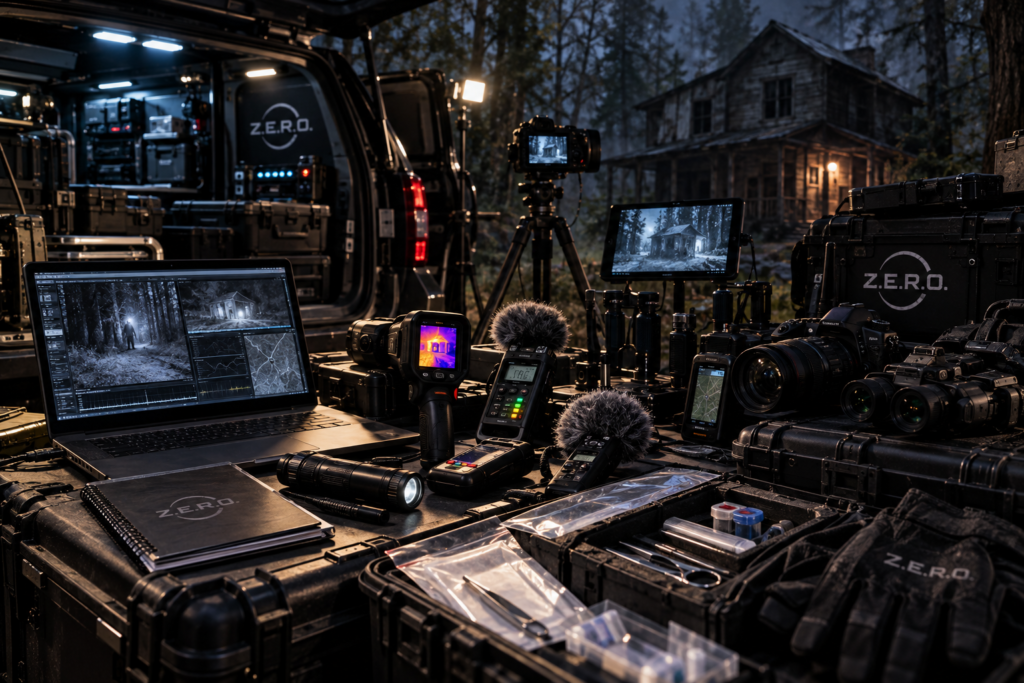
When the unexplained becomes an investigation, technology provides the tools to separate observation from assumption.
Investigating an unexplained event requires more than curiosity and a willingness to venture into unfamiliar territory. It demands preparation, patience, scientific reasoning, and the ability to document evidence under conditions that may be unpredictable or potentially dangerous.
Within the fictional world of Z.E.R.O. — Zero Event Response Organization, technology plays an essential role in understanding phenomena that cannot always be explained through conventional scientific knowledge.
Whether investigators are examining an unusual environmental disturbance, documenting a reported encounter, or attempting to identify an unknown biological organism, the equipment they carry can determine how much useful information survives the investigation.
But technology has limitations. Even the most sophisticated instruments cannot automatically explain something that has never been encountered before.
The challenge is knowing what to measure, how to interpret the results, and when to recognize that the available information is insufficient to reach a conclusion.
Before the Investigation Begins
Every successful investigation starts with preparation.
Before entering an unfamiliar environment, investigators must consider the location, reported activity, potential hazards, accessibility, weather conditions, and available background information.
A remote forest requires different equipment from an abandoned industrial building. An investigation involving unusual electromagnetic activity presents different challenges from one involving unexplained biological evidence.
Equipment must be selected according to the circumstances rather than carried simply because it appears impressive.
Within Z.E.R.O., preparation also involves determining what personnel and specialized resources may be needed. Scientific researchers, technical specialists, and field investigators bring different areas of expertise to an operation.
No single instrument, or individual, can provide every answer.
Visual Documentation: Cameras and Recording Systems
One of the most important tools available to any investigator is a reliable camera.
Photographs and video recordings preserve visual information that may otherwise be forgotten, misremembered, or overlooked. They can document environmental conditions, physical evidence, structural damage, unusual markings, and the position of objects before anything is disturbed.
Modern investigative equipment may include high-resolution digital cameras, body-worn cameras, stationary surveillance systems, and low-light recording devices.
Each serves a different purpose.
Body cameras can provide a continuous record of an investigator’s movements and observations, while stationary cameras allow an area to be monitored without requiring someone to remain physically present.
However, recording something unusual is only the beginning.
Reflections, insects near camera lenses, airborne particles, compression artifacts, and changing light conditions can all create images that appear mysterious.
Responsible investigators must examine these possibilities before treating a recording as evidence of an extraordinary event.
A camera can document what appears to have happened. It cannot, by itself, establish why it happened.
Thermal Imaging and Infrared Technology
Thermal imaging cameras detect infrared radiation and produce images representing differences in apparent surface temperature.
These instruments are useful in search-and-rescue operations, industrial inspections, wildlife observation, and security applications.
Within a paranormal investigation, thermal imaging may help identify unusual temperature patterns, locate people or animals in darkness, or reveal environmental conditions that would otherwise be difficult to observe.
But thermal imaging is frequently misunderstood.
A thermal camera does not directly photograph ghosts, spirits, or supernatural energy. It measures infrared radiation, and its readings can be affected by reflective surfaces, material properties, atmospheric conditions, and the equipment’s settings.
Likewise, a cold area within a building does not automatically indicate paranormal activity.
Air circulation, insulation problems, moisture, ventilation systems, and structural differences can produce substantial temperature variations.
For Z.E.R.O. investigators, thermal imaging provides another source of measurable information rather than an automatic explanation.
Environmental Monitoring and Sensor Technology
Unusual environmental conditions can play an important role in investigating reported phenomena.
Depending on the situation, investigators may use instruments designed to monitor temperature, humidity, atmospheric pressure, electromagnetic fields, air quality, and other measurable variables.
These devices help establish baseline conditions and identify changes that occur during an investigation.
For example, an electromagnetic field meter can detect certain electromagnetic fields associated with electrical systems, machinery, and other sources.
However, an unusual electromagnetic reading does not establish the presence of a supernatural entity. Electrical wiring, electronic equipment, nearby infrastructure, and interference may explain the measurement.
The same principle applies to atmospheric sensors.
A sudden change in pressure or temperature may be significant, but it must be evaluated alongside the surrounding conditions and other available evidence.
The purpose of environmental monitoring is not to make every unusual reading seem mysterious.
It is to determine whether a measurable change occurred and whether a conventional explanation can account for it.
Audio Recording and Acoustic Analysis
Sound can be especially difficult to interpret in unfamiliar environments.
Buildings expand and contract as temperatures change. Air moving through narrow openings can create unusual tones. Animals produce vocalizations that may be unfamiliar to listeners, particularly at night.
Even ordinary mechanical systems can generate sounds that seem difficult to locate.
High-quality digital audio recorders, directional microphones, and acoustic monitoring equipment can help investigators document these events.
When a recording captures something unexpected, analysts can examine its frequency characteristics, timing, background noise, and possible sources.
Audio analysis may reveal details that are difficult to recognize during the original recording.
Nevertheless, caution is necessary.
Human hearing and perception are susceptible to suggestion. When listeners expect to hear words within an ambiguous recording, they may interpret random sounds as recognizable speech.
For that reason, investigators should preserve original recordings and avoid treating subjective interpretations as established facts.
Within Z.E.R.O., reliable documentation matters more than dramatic assumptions.
Evidence Collection and Preservation
Not every investigation involves unusual lights, sounds, or environmental disturbances.
Some may produce physical evidence.
Unknown fibers, biological material, soil disturbances, damaged vegetation, unusual residues, and unidentified substances can provide valuable information when collected and preserved correctly.
Investigators may require protective gloves, sterile collection containers, evidence bags, measuring instruments, photographic scales, and specialized sampling tools.
The methods used depend on the type of evidence involved.
Biological samples may require temperature-controlled storage, while other materials must be protected from moisture, contamination, or chemical degradation.
Accurate labeling and chain-of-custody documentation are equally important.
Investigators need to establish where an item was found, who handled it, how it was collected, and what happened to it afterward.
Without that information, even an extraordinary specimen may have limited scientific value.
For Z.E.R.O., preserving the integrity of evidence is essential to understanding events that may challenge existing knowledge.
Communications and Field Safety
Communication equipment is sometimes less exciting than cameras or advanced sensors, but it can be far more important when an investigation becomes dangerous.
Reliable communication allows field personnel to coordinate their movements, request assistance, exchange observations, and report changing conditions.
Depending on the environment, teams may rely on portable radios, vehicle communication systems, satellite communication devices, and other equipment suited to their operational needs.
Remote locations can introduce additional complications.
Mountainous terrain, underground structures, dense construction materials, and distance may interfere with conventional communication systems.
Investigators must understand these limitations before entering an area.
Personal protective equipment, emergency medical supplies, navigation systems, and appropriate lighting are also fundamental components of field preparation.
Technology should not merely help investigators discover something unusual.
It should help ensure they can return safely with the information they have collected.
Mobile Research and Specialized Transportation
Some investigations require equipment that cannot easily be carried by individual personnel.
Mobile operations may involve vehicles capable of transporting technical instruments, containment supplies, protective equipment, and specialized research personnel.
A mobile command arrangement can also provide a location for coordinating activities, reviewing incoming information, and maintaining communication with investigators in the field.
Within the Z.E.R.O. universe, transportation and logistical support are particularly important because investigations can occur in widely different environments.
Remote wilderness locations, waterways, isolated facilities, and difficult terrain may require different transportation resources.
The ability to move personnel and equipment efficiently can influence how quickly an organization responds to an emerging situation.
And when the nature of an event remains unknown, flexibility becomes essential.
When Field Equipment Is No Longer Enough
Field investigations can reveal information that requires more extensive examination.
A recovered sample may need laboratory analysis. An unidentified organism may require specialized biological research. An unfamiliar material might need to be examined using instruments unavailable outside a controlled scientific facility.
This is where the relationship between field investigators and laboratory researchers becomes especially important.
Z.E.R.O.’s research facilities provide an environment in which collected evidence can be studied using more specialized resources.
Laboratory analysis may involve microscopy, chemical testing, biological examination, imaging systems, and controlled observation.
Depending on the nature of the evidence, additional safety precautions or containment procedures may be necessary.
But sophisticated laboratory equipment does not guarantee immediate answers.
An unfamiliar substance may produce unexpected results. An organism may exhibit characteristics that cannot readily be classified. Measurements may contradict established expectations.
These situations require careful experimentation, repeated observations, and collaboration between specialists.
Sometimes the most scientifically responsible conclusion is simply that further research is needed.
The Difference Between Detection and Understanding
One of the most important distinctions in any investigation is the difference between detecting an anomaly and understanding its cause.
A sensor may register an unexpected change. A camera may capture an unidentified object. A laboratory instrument may produce an unusual result.
Those observations can justify further investigation, but they do not automatically prove an extraordinary explanation.
In scientific research, an anomaly is generally something that differs from an expected pattern or result.
It is not necessarily evidence of the supernatural.
This distinction is particularly important within the world of Z.E.R.O., where investigators may encounter situations that do not fit established scientific expectations.
Their responsibility is not to force every observation into an existing explanation or assume that every mystery has a paranormal cause.
It is to gather reliable information, evaluate competing possibilities, and remain willing to reconsider conclusions when new evidence becomes available.
Technology Cannot Replace Human Judgment
Despite the importance of advanced equipment, technology is only as useful as the people operating and interpreting it.
An experienced investigator may recognize that an unusual sound has a natural source. A researcher may identify a flaw in an instrument’s calibration. A technical specialist may discover that an apparent anomaly resulted from interference.
Human observation, critical thinking, communication, and scientific curiosity remain essential.
Technology can extend our senses, preserve information, and reveal patterns that would otherwise remain hidden.
But it cannot eliminate uncertainty.
And in some situations, an investigator’s most important decision may be recognizing when there is insufficient evidence to continue safely.
That balance between scientific capability and human judgment is central to the way I envision Z.E.R.O. operating.
Investigating the Impossible
The equipment behind a paranormal investigation is not valuable because it looks futuristic or produces mysterious readings.
It is valuable because it allows investigators to approach uncertainty with greater precision, consistency, and responsibility.
Cameras preserve what was seen. Sensors measure environmental conditions. Recording systems capture information that might otherwise disappear. Laboratory instruments allow recovered evidence to be examined in controlled environments.
Together, these technologies provide a foundation for investigating events that may initially seem impossible.
As the Z.E.R.O. universe continues to develop, technology will remain an important part of its scientific and investigative operations.
But no matter how advanced the equipment becomes, the fundamental questions remain the same.
What happened? What evidence supports the observations? Can the event be explained? And what remains unknown?
Because the purpose of an investigation isn’t to prove that something impossible exists. It’s to discover what the evidence can actually tell us.
Ginger Yarbrough
Creator and Author of Z.E.R.O. — Zero Event Response Organization