Why the Human Element Matters in Paranormal Horror
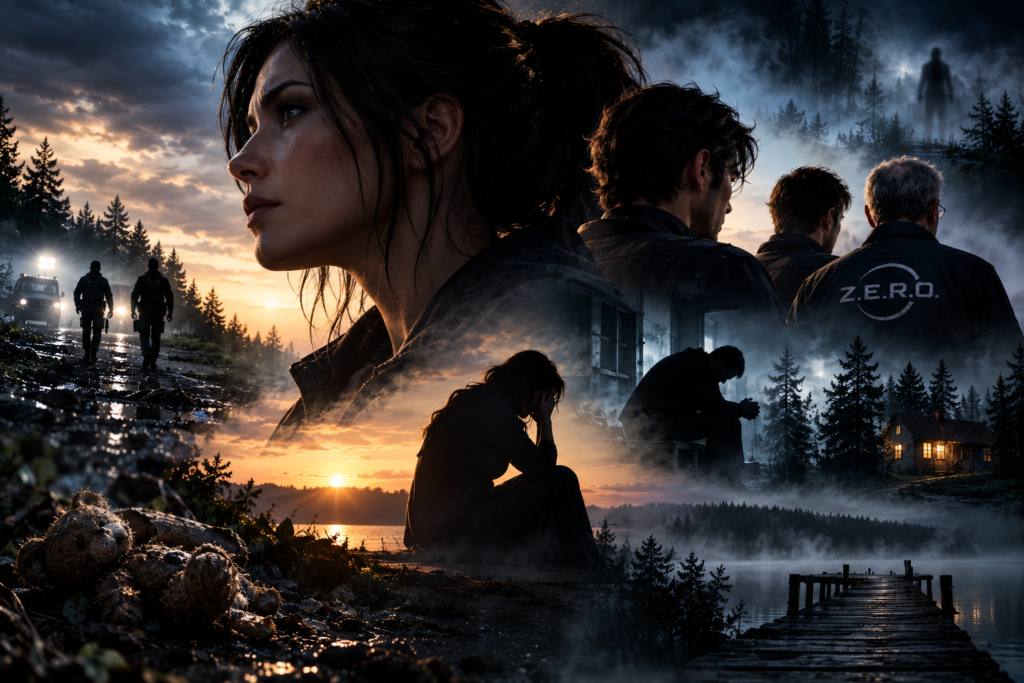
The unknown may create the fear, but it’s the human experience that gives that fear meaning.
Paranormal horror has always fascinated audiences with the possibility that something exists beyond our understanding. Unexplained creatures, mysterious disappearances, strange phenomena, and encounters that challenge everything we believe about reality can create an extraordinary sense of fear and curiosity.
But what makes these stories truly memorable?
Is it the creature hiding in the darkness? The unexplained sound coming from an empty room? The realization that something impossible has just happened?
Those elements certainly contribute to the experience, but I believe the most powerful part of paranormal horror is often something much more familiar.
The people caught in the middle of it.
When I began developing Z.E.R.O. — Zero Event Response Organization, I wanted to create more than a fictional organization investigating strange events. I wanted to explore what happens to ordinary people when they encounter extraordinary circumstances, and what those experiences mean for the individuals responsible for investigating them.
Because no matter how unusual the phenomenon might be, the people involved are still human.
Fear Is More Than a Reaction
Fear is one of the most recognizable human emotions, but it doesn’t affect everyone in the same way.
One person might freeze when confronted with something terrifying. Another might run without thinking. Someone else might become unusually calm, concentrating entirely on finding a way out of the situation.
And sometimes, people make decisions that seem completely irrational to an outside observer.
That’s part of what makes human behavior so interesting.
Imagine witnessing something that shouldn’t exist. Something that contradicts everything you’ve learned about the natural world. Even if you escape unharmed, how do you explain what happened?
Would you tell someone? Would they believe you? Would you begin questioning your own memory?
The encounter itself might last only a few minutes, but the psychological effects could remain for years.
In paranormal horror, the consequences of an experience can be just as compelling as the experience itself.
The People Behind the Investigations
One of the things I wanted to establish within Z.E.R.O. is that the agents and researchers aren’t fearless superheroes.
They’re individuals with different personalities, backgrounds, skills, opinions, and emotional responses.
They may have access to specialized equipment, scientific resources, and information unavailable to the general public, but none of those advantages eliminates the uncertainty of confronting something unknown.
Experience doesn’t make someone immune to fear.
A trained investigator can still be startled. A scientist can still become frustrated when the evidence refuses to make sense. An experienced agent can make a mistake or struggle with a decision long after an investigation has ended.
These are the qualities that make characters believable.
I also believe it’s important for characters to contribute in different ways. Not every problem can be solved through physical strength, scientific knowledge, or technological innovation alone.
Sometimes the most valuable contribution comes from careful observation, an unexpected idea, or simply recognizing something everyone else has overlooked.
The relationships between the characters matter, too. Trust, friendship, disagreement, humor, and mutual respect can influence how people respond when circumstances become dangerous.
Those interactions help establish that the characters have lives and personalities beyond their investigations.
The Victims Are More Than Part of the Mystery
In paranormal fiction, it’s easy for victims to become little more than evidence that something dangerous exists.
A mysterious disappearance introduces the investigation. An unexplained death establishes the threat. A frightened witness provides the information needed to move the story forward.
But I think there’s something important that can be lost when victims are treated only as plot devices.
Every victim had a life before becoming part of an investigation.
They had families, friends, responsibilities, ambitions, and ordinary routines. They might have been looking forward to a vacation, returning home from work, or simply enjoying a quiet evening when something happened that changed everything.
Their experiences matter.
The same is true for witnesses and survivors. Someone who has encountered something extraordinary may be frightened, confused, embarrassed, or reluctant to speak about what happened.
They might be struggling to understand the event themselves.
For the investigators, gathering evidence is important, but so is recognizing the human being providing that evidence.
A person who has experienced something traumatic isn’t simply a source of information.
They’re someone whose life may never be quite the same.
The Unknown Doesn’t Always Have to Be Evil
Another aspect of paranormal horror that interests me is the tendency to assume that anything unfamiliar must be dangerous.
Certainly, some fictional entities are terrifying because they represent a genuine threat. Their behavior may be predatory, destructive, or completely indifferent to human suffering.
But unfamiliarity and evil aren’t necessarily the same thing.
What if an unusual creature is simply trying to survive? What if something behaves aggressively because it’s frightened? What if an encounter becomes dangerous because humans misunderstand what they’re witnessing?
These possibilities create opportunities for stories that go beyond a straightforward confrontation between humans and monsters.
They also introduce difficult questions.
How do you determine whether something is dangerous when you don’t understand its behavior? At what point does observation become interference? How much risk is acceptable when attempting to study an unknown life-form?
There may not always be an obvious answer.
And sometimes, the most frightening discovery isn’t that something unknown exists.
It’s realizing how little we understand about it.
The Importance of Ordinary Moments
When people think about paranormal horror, they often imagine dramatic encounters, dark environments, disturbing discoveries, and moments of intense suspense.
Those elements are important, but I believe quieter moments deserve just as much attention.
Characters need opportunities to talk, laugh, disagree, reflect, and simply exist outside the immediate danger.
A conversation over a meal can reveal something about a character that an entire action sequence cannot. A moment of humor following a stressful investigation can demonstrate how people cope with difficult experiences.
Even a small disagreement can reveal the different ways characters approach problems.
These ordinary interactions create familiarity.
They allow readers to understand the people involved before placing them in extraordinary situations.
And when readers begin caring about the characters, the danger becomes more meaningful.
A frightening encounter is one thing.
A frightening encounter involving someone you’ve come to know and care about is something entirely different.
Not Every Story Needs a Perfect Ending
One of the realities I want reflected in Z.E.R.O. is that not every situation can be resolved exactly as everyone hopes.
Sometimes investigators may find the answers they’re searching for. Sometimes they may prevent a tragedy or discover something extraordinary.
Other times, the outcome may be complicated.
Evidence can be incomplete. Decisions can have unintended consequences. People can make mistakes despite having the best intentions.
And occasionally, there may simply be no way to undo what has happened.
That doesn’t mean every story needs to end in tragedy. Hope, survival, discovery, and even happiness have their place.
But I don’t believe every investigation should conclude with everything neatly explained and everyone walking away unharmed.
Uncertainty is part of the human experience, and it’s especially important in stories about the unknown.
The emotional consequences of an investigation can continue long after the immediate danger has passed.
Why Character Development Matters
A fictional universe becomes more interesting when its characters are allowed to grow.
Experiences should have meaning beyond the individual stories in which they occur.
A character might become more confident after overcoming a difficult situation. Another might begin questioning something they once believed without hesitation.
Friendships can deepen. Trust can develop gradually. Conflicting personalities can learn to work together, even when they don’t always agree.
And sometimes, an experience may reveal a side of a character that neither the reader nor the character expected.
I enjoy exploring these possibilities because they make the fictional world feel connected.
The characters aren’t simply reset at the beginning of every new investigation. They carry their personalities, relationships, experiences, and memories with them.
That continuity helps create the feeling that their lives continue even when readers aren’t following them through a particular story.
For me, that’s an important part of building the Z.E.R.O. universe.
The Real Power of Paranormal Horror
A frightening creature can capture someone’s attention. An unexplained event can create suspense. A mysterious location can establish an atmosphere that makes readers uneasy before anything unusual even happens.
But none of those elements exists in isolation.
It’s the human response that gives them emotional weight.
We understand fear because we’ve experienced it. We recognize grief, curiosity, anger, compassion, determination, and hope because they’re part of our own lives.
When fictional characters experience those emotions in extraordinary circumstances, the impossible begins to feel a little more believable.
Readers may never encounter an unknown creature or investigate a mysterious disturbance, but they can understand what it means to be frightened, to protect someone they care about, or to search for answers when nothing makes sense.
That connection is what allows paranormal horror to become something more than a collection of frightening events.
It becomes a story about people.
Beyond the Monsters
As I continue developing Z.E.R.O. — Zero Event Response Organization, the mysteries, creatures, investigations, and scientific possibilities will remain essential parts of the fictional universe.
But the characters and the people affected by those investigations will always be just as important.
I want readers to experience the suspense of confronting the unknown, but I also want them to understand the individuals standing in front of it.
Their fears. Their decisions. Their relationships. Their mistakes. Their courage.
Because sometimes the most memorable part of a paranormal story isn’t the thing waiting in the darkness.
It’s what the people who encounter it choose to do next.
Ginger Yarbrough
Creator and Author of Z.E.R.O. — Zero Event Response Organization